Is It Correct to Say ‘less people’?
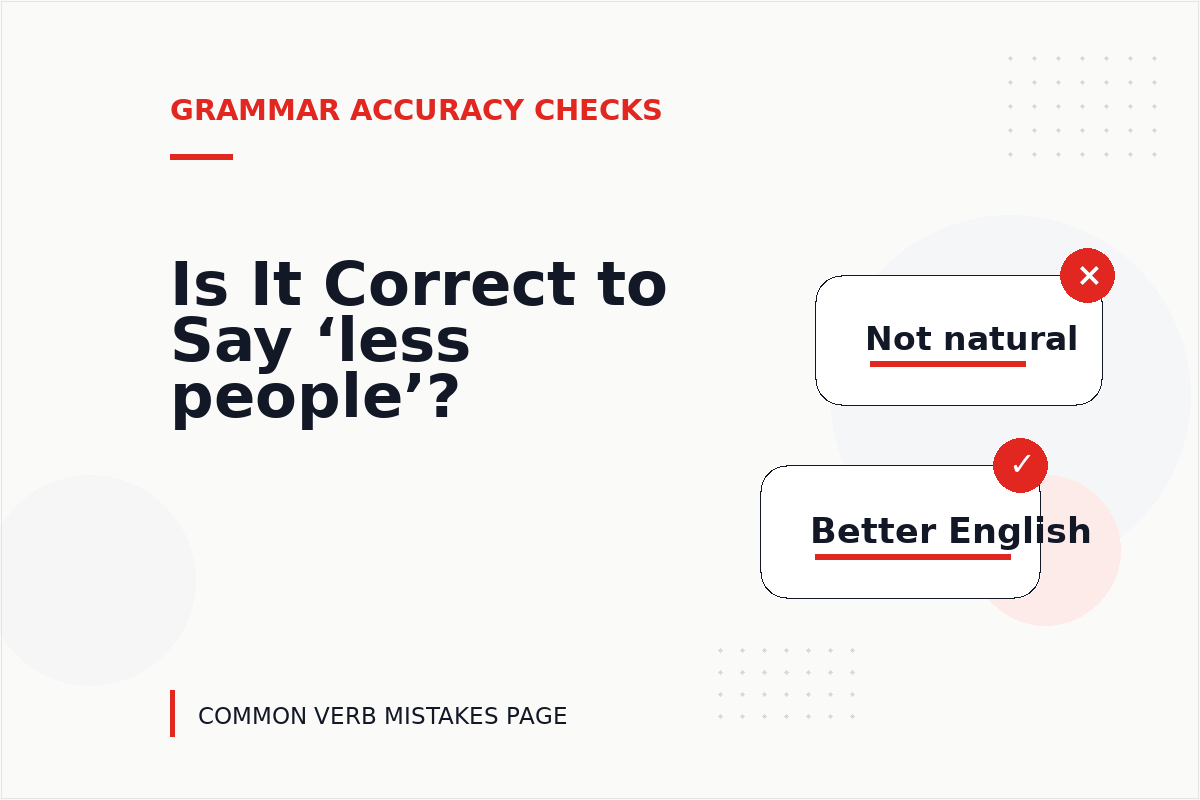
No, it is not grammatically correct to say “less people” in standard English. The word “people” is a countable noun (you can count individual persons), so the correct quantifier is “fewer.” The rule is simple: use “fewer” for things you can count (fewer chairs, fewer mistakes, fewer people) and “less” for things you cannot count (less water, less time, less traffic). Saying “less people” is one of the most common verb and quantifier mistakes in everyday English, and it often sounds informal or uneducated in professional writing.
Quick Answer
Correct: “fewer people” (for countable nouns)
Incorrect: “less people” (common mistake)
Rule: Use “fewer” with plural countable nouns (people, cars, books). Use “less” with uncountable nouns (money, information, work).
Why This Mistake Happens
Many English learners and even native speakers say “less people” because “less” feels more natural in casual conversation. The confusion grows because “less” is often used with numbers, distances, and sums of money (e.g., “less than 10 dollars” or “less than 5 miles”). However, when you are talking about individual items or people, “fewer” is the standard choice. In formal writing, emails to clients, or academic work, using “fewer people” shows you understand the nuance of countable versus uncountable nouns.
Comparison Table: Fewer vs. Less
| Use “Fewer” (Countable) | Use “Less” (Uncountable) |
|---|---|
| fewer people | less traffic |
| fewer chairs | less furniture |
| fewer emails | less email |
| fewer mistakes | less time |
| fewer students | less homework |
| fewer cups of coffee | less coffee |
Natural Examples
Here are real-life examples showing the correct use of “fewer people” and “less” in context.
In Conversation
- “There were fewer people at the park today because of the rain.” (Correct)
- “I wish there were less people in this line.” (Incorrect – should be “fewer people”)
- “We need less sugar in this recipe.” (Correct – sugar is uncountable)
In Email and Professional Writing
- “Our team has fewer people this quarter, but productivity is up.” (Correct for a business email)
- “We received fewer complaints after updating the policy.” (Correct)
- “There is less confusion now that the instructions are clear.” (Correct – confusion is uncountable)
In Formal Writing
- “The study found that fewer people are smoking compared to a decade ago.” (Correct)
- “With fewer resources, the team still achieved its goals.” (Correct)
Common Mistakes
Here are the most frequent errors learners make with “less people” and similar phrases.
Mistake 1: Using “less” with countable nouns
Incorrect: “There are less cars on the road today.”
Correct: “There are fewer cars on the road today.”
Mistake 2: Using “less” with “people” in formal contexts
Incorrect: “Less people attended the meeting than expected.”
Correct: “Fewer people attended the meeting than expected.”
Mistake 3: Confusing “less” with numbers
Incorrect: “I have less than 20 people in my class.” (This is tricky – “less than 20” is acceptable when referring to a total number, but “fewer than 20 people” is more precise.)
Better: “I have fewer than 20 people in my class.”
Mistake 4: Overcorrecting
Some learners start using “fewer” for everything, even uncountable nouns.
Incorrect: “I need fewer water.”
Correct: “I need less water.”
Better Alternatives and When to Use Them
If you are unsure whether to use “fewer” or “less,” try these strategies.
When to Use “Fewer”
- When you can count the items individually: people, chairs, emails, mistakes, students, cups, books, tickets.
- In formal writing, business reports, academic papers, and professional emails.
- When you want to sound precise and careful with language.
When to Use “Less”
- When the noun is uncountable: water, time, money, traffic, information, work, sugar, air, patience.
- When referring to a single amount or quantity: “less than 10%,” “less than a mile.”
- In casual conversation, many native speakers use “less” with countable nouns, but it is still considered a mistake in careful English.
Better Alternatives for “Less People”
- Fewer individuals – more formal and precise.
- A smaller number of people – clear and natural.
- Not as many people – good for conversation.
- Reduced attendance – for business or event contexts.
Mini Practice Section
Test your understanding with these four questions. Choose the correct word: fewer or less.
Question 1
“We need _____ chairs for the meeting tomorrow.”
Answer: fewer (chairs are countable)
Question 2
“There is _____ milk in the fridge than I thought.”
Answer: less (milk is uncountable)
Question 3
“_____ people are using public transport this year.”
Answer: Fewer (people are countable)
Question 4
“I have _____ patience for these delays.”
Answer: less (patience is uncountable)
FAQ
1. Is “less people” ever acceptable?
In very informal spoken English, some native speakers say “less people,” but it is not considered correct in standard grammar. Avoid it in writing, emails, or any professional setting. Stick with “fewer people” for accuracy.
2. What about “less than 10 people”? Is that wrong?
This is a gray area. Many grammar guides accept “less than” with numbers (e.g., “less than 10 people”) because the phrase refers to a total quantity. However, “fewer than 10 people” is more precise and preferred in formal English. When in doubt, use “fewer” with people.
3. Can I use “less” with “people” if I mean “less population”?
No. “Population” is a singular noun, so you could say “less population” (though “smaller population” is better). But “people” is plural and countable, so it always takes “fewer.”
4. How can I remember the difference?
Think of the word “count.” If you can count the noun (one person, two people), use “fewer.” If you cannot count it (you cannot say “one water”), use “less.” A simple trick: “fewer” for things you can count on your fingers, “less” for everything else.
Final Note
Mastering the difference between “fewer” and “less” is a small change that makes a big impact on your English accuracy. Whether you are writing a business email, preparing a report, or having a conversation, using “fewer people” instead of “less people” shows attention to detail. For more help with common verb and quantifier mistakes, explore our Grammar Accuracy Checks section. If you have questions about other tricky phrases, visit our FAQ page or contact us for guidance.