
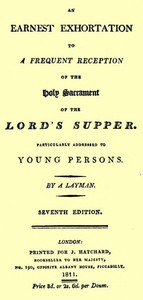
An Earnest Exhortation to a Frequent Reception of the Holy Sacrament of the…
Let's be honest, a book with this title doesn't exactly scream 'page-turner.' Published in 1801, it's a theological pamphlet by James Allan Park, a British judge and clergyman. But don't let that fool you. This isn't a cold set of instructions; it's a warm, persuasive plea written directly to his congregation.
The Story
There isn't a plot in the traditional sense. Think of it as a long, thoughtful sermon or a personal letter from a pastor who's worried about his people. Park noticed that many Anglicans in his day were receiving Holy Communion only once or twice a year, if at all. They stayed away because they felt they weren't good enough, or they didn't understand its importance. His book is his response. He walks the reader through all the common excuses—'I'm not worthy,' 'I don't feel it enough,' 'It's just a ritual'—and gently but firmly argues against each one. His core message is an invitation: this sacrament is a gift of grace, not a reward for being perfect, and to avoid it is to miss out on a vital source of spiritual strength.
Why You Should Read It
I picked this up out of historical curiosity, but I was struck by its humanity. Park isn't some distant authority figure scolding from on high. You can feel his pastoral concern. He's talking to real people with real anxieties. When he writes about feeling unworthy, it's not a theoretical concept; it's the voice of someone who has listened to countless confessions and knows how heavy that feeling can be. His arguments are steeped in scripture, but they're delivered with a kindness that makes them accessible. Reading it, you get a clear window into the religious anxieties of early 19th-century England, but also into timeless human struggles with doubt, guilt, and the desire for connection with the divine.
Final Verdict
This is a niche read, but a rewarding one. It's perfect for history buffs interested in everyday religion in the Regency era, or for modern churchgoers who might recognize some of these same hesitations today. If you enjoy primary sources that let you hear an authentic voice from the past, Park's 'Earnest Exhortation' is a short, sincere, and insightful example. It's not a thrilling novel, but as a record of one man's attempt to bridge the gap between faith and practice, it has a quiet power that lingers.
This content is free to share and distribute. It is now common property for all to enjoy.
William Taylor
1 year agoIt took me a while to process the complex ideas here, but the quality of the diagrams and illustrations (if applicable) is top-notch. I feel much more confident in my knowledge after finishing this.
Linda Gonzalez
3 months agoThis is an essential addition to any academic digital library.
George Moore
2 years agoThe author provides a very nuanced critique of current methodologies.
Michael Thomas
10 months agoThought-provoking and well-organized content.

Jennifer Jones
9 months agoI wanted to compare this perspective with traditional views, it manages to maintain a consistent flow even when discussing difficult topics. Truly a masterpiece of digital educational material.