
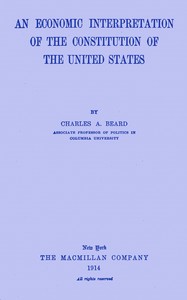
An economic interpretation of the Constitution of the United States by Beard
So, what's this book actually about? Let's break it down simply.
The Story
Charles Beard looks at the United States Constitution not as a sacred text that dropped from the sky, but as a document written by real people in a specific time. In the 1780s, the country was struggling under the Articles of Confederation. Debt from the Revolutionary War was crushing, trade was a mess, and paper money was basically worthless. This was bad news for a lot of people, but especially for a group of wealthy men—creditors who were owed money, bondholders who owned government debt, and merchants who needed stable commerce.
Beard's big idea is this: The Founding Fathers who gathered in Philadelphia weren't just thinking about 'freedom' in the abstract. They were also protecting their wallets. He goes through the list of delegates, looking at what they owned and what they owed. He argues that the Constitution's strong central government, its power to tax, and its protection of contracts were direct answers to their personal financial problems. In short, they had a major economic stake in creating a new system.
Why You Should Read It
You should read this book because it makes history feel real. It takes the founders off their pedestals and puts them back in their counting houses. It's not saying they were greedy villains; it's saying they were complex humans with property, families, and investments to protect. This perspective is incredibly refreshing. It adds a layer of gritty, practical motivation to a story we often tell as pure idealism.
Reading Beard is like getting the director's commentary on the founding of America. You see the set design, the budget constraints, and the personal stakes of the actors. It doesn't diminish what they created, but it makes the achievement seem even more remarkable—a document that served both high ideals and immediate, practical needs.
Final Verdict
This book is perfect for anyone who loves American history but is tired of the fairy-tale version. It's for the reader who asks 'why?' and 'who benefits?'. Be warned: it was written in 1913, so some of the writing feels a bit dense, and later historians have challenged parts of his research. But that's part of the fun! You're engaging with an argument that has sparked debate for over a century. If you want to understand a foundational—and controversial—way of looking at America's origins, this is your essential, thought-provoking starting point.
No rights are reserved for this publication. It is available for public use and education.
Donna Davis
2 years agoIf you enjoy this genre, the author's voice is distinct and makes complex topics easy to digest. Worth every second.
Liam Flores
4 months agoA bit long but worth it.
Kimberly King
1 year agoI came across this while browsing and the character development leaves a lasting impact. A valuable addition to my collection.
Ava Hernandez
8 months agoThis is one of those stories where the clarity of the writing makes this accessible. Exactly what I needed.


Ashley Harris
2 months agoThe methodology used in this work is academically sound.