About 203 minutes
Sweet P's — Text and Context
Childrens Adventures
46,584 recorded words. 1 minutes difference from this book's estimate.
View Gutenberg source #53663
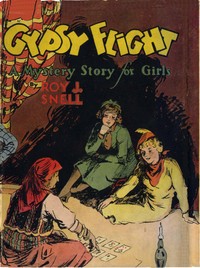
Before opening Gypsy Flight A Mystery Story for Girls — Text and Context, the edition data offers a quick orientation: 46,895 words, 3 hr 24 min estimated reading time, and 7 detected text sections.
The text analysis averages about 11.5 words per sentence, while the detected sections provide another way to judge how the source is divided.
Project Gutenberg metadata also associates the work with “Mystery and detective stories,” connecting these edition facts with the source record’s subject description.
Explore this collection
These alternatives are selected using recorded categories and estimated reading time.
About 203 minutes
Childrens Adventures
46,584 recorded words. 1 minutes difference from this book's estimate.
View Gutenberg source #53663About 207 minutes
Childrens Adventures
47,459 recorded words. 3 minutes difference from this book's estimate.
View Gutenberg source #45663About 198 minutes
Childrens Adventures
45,465 recorded words. 6 minutes difference from this book's estimate.
View Gutenberg source #50794Search stored excerpts and compare books → Choose by your preferences →
Choices use stored catalog measurements. Estimates vary with reading speed. A shared category is a catalog label, not a claim that two books have the same argument or literary quality.
Search reads excerpt text stored with this catalog and links to its associated Gutenberg record. The connection is stored in the site database; this tool does not recheck that every excerpt is word-for-word identical to that external record. Excerpt search does not cover every chapter and does not verify historical publication dates.
Catalog snapshot checked: 2026-09-25. Coverage: 98 public books, 98 available source excerpts.
Calculated from edition completeness, EPUB availability, text structure and catalogue metadata. Not a user rating.
Total of 100 points, scaled to a 2.5-5.0 range. Editions with an empty description or a missing EPUB file are not scored.
Public-domain source text
The source text is kept in the dedicated reader, separate from this catalogue record and its commentary.
From the opening paragraph, Gypsy Flight establishes a world of polished surfaces. Rosemary Sample steps onto a cement runway with a buoyant tread, and the airport is described as a place of “perfection itself”—spotless floors, silver birds, and perfect unison. Yet this pristine order is immediately disrupted by a young man who grasps her arm and speaks in a “low hoarse whisper.” The pattern recurs throughout the excerpts: a controlled, modern environment (airplane, mill, depot) is punctured by a secret, a whisper, or a suspicious figure. The narrative moves between these two poles—the orderly and the clandestine—using the contrast to generate suspense.
The opening chapter treats the airport as a theatrical space where every element is arranged for perfection. Rosemary observes the “giant silver birds,” the “hard white floor,” and the travelers who “fit in” without shabbiness. The language is almost reverent: motors drum in “perfect unison,” and the care of the planes surpasses that of “the most valuable horse.” This idealized setting makes the intrusion of the whispering young man all the more jarring. Snell uses the airport not merely as a backdrop but as a symbol of control—a place where rules (like Rule No. 1 for hostesses) govern behavior. The violation of that rule signals that the story will operate in the gap between surface order and hidden disorder.
Surveillance is a central structural device. Florence, introduced later as a “Lady Cop,” spends her days “watching, watching, watching.” She notes that the mill is “enchanting” and the city “happy,” but she cannot allow herself to be “lulled into inaction.” The excerpts show her cataloging suspects: the Dvorac sisters, Hans Schneider the electrician, and Ina Piccalo, who slips out with a bottle of dye. Each observation is precise—the sisters are “dark-complexioned,” the German is “weasel-faced,” Ina’s eyes are “black as night.” The narrative itself adopts a detective’s gaze, lingering on details that might prove significant. This pattern of scrutiny extends to the reader, who is invited to share Florence’s suspicion.
The title Gypsy Flight yokes two opposing ideas: the settled, mechanical world of flight and the wandering, unpredictable life of the gypsy. The excerpts reflect this tension through movement. Rosemary steps from her plane onto the runway; Florence moves from the mill’s gymnasium to the dyeing room to the children’s playground. The narrative shifts between the airport’s gleaming depot and the “mere shack” of the Dvorac sisters, between the mill’s ordered looms and the “golden glow of autumn” outside. This back-and-forth creates a rhythm of exposure and concealment. Florence’s inner warning—“I must not allow myself to be lulled into inaction”—echoes the reader’s sense that any setting, no matter how peaceful, may hide a spy.
Images of flight appear alongside images of confinement. Rosemary’s plane is a “huge bi-motored” machine with “555 horse-power motors,” yet she is its stewardess, bound by duty. The mill’s workers are tied to looms and spinning machines; Ina Piccalo is caught carrying dye in an ink bottle. Even the gypsy trail, evoked in chapter titles, suggests a path that is both free and constrained. The airplane, the mill, the city—all are places where movement is possible but regulated. Snell uses these recurring images to build a world where characters are always in transit, yet never entirely free. The mystery hinges on who can move undetected across these boundaries.
Readers attentive to the interplay of setting and surveillance will find that Gypsy Flight rewards close attention to its transitions. The story’s power lies not in sudden twists but in the steady accumulation of observed details—a whispered name, a bottle of dye, a weasel-faced electrician. The narrative asks us to watch as its heroines watch, and to question the perfection of every polished surface.
Re-reading about the gypsy trail in Gypsy Flight, I found myself thinking of how much quieter the corridors felt in The Adventure Girls at Happiness House — Context and Discussion. Both books share that slow, watchful feeling—of girls glancing over shoulders, moving between rooms and open fields. It’s a curious intimacy, being alone together in a story told sideways.
A brief reflection can help important ideas stay with you longer.









