
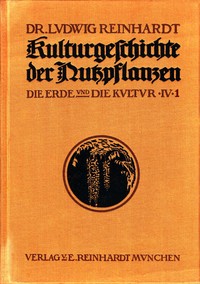
Kulturgeschichte der Nutzpflanzen, Band IV, 1. Hälfte by Ludwig Reinhardt
This book is a journey through time, told from the perspective of plants. Ludwig Reinhardt, writing over a century ago, pieces together the forgotten history of our most important crops. He doesn't just list facts; he follows the trails of evidence left in ancient texts, archaeological finds, and old farming practices. The story is about transformation—how a handful of wild grasses in the Middle East became the global staple of wheat, and how a bitter berry in Ethiopia became the fuel for modern life as coffee.
The Story
There's no traditional plot with characters, but the narrative is driven by a simple, powerful question: how did we get here? Reinhardt explores this by focusing on specific plants in this volume. He reconstructs their origins, tracks their migration along trade routes and with conquering armies, and shows how they changed diets, economies, and even social structures. It's the biography of species like the grapevine and the olive tree, showing their role in building religions, funding empires, and sparking revolutions. The 'conflict' is the constant struggle against nature, famine, and the sheer challenge of turning a wild thing into a reliable source of food and material.
Why You Should Read It
Reading this changes how you see the world. You'll never look at a garden, a supermarket aisle, or a historical painting the same way. Reinhardt connects dots you didn't know existed. That cinnamon in your cupboard? Its history is wrapped up in ancient myths and perilous sea voyages. The cotton in your t-shirt has a political past. The book makes you realize that human history is, in a very literal sense, rooted in the soil. It's humbling and incredibly interesting to see our grand narratives of kings and wars underpinned by the successful cultivation of a few crucial plants.
Final Verdict
This is a specialized book, but it's absolutely perfect for a specific reader. If you're a history fan who enjoys looking at the big picture from an unexpected angle, you'll love it. Gardeners and foodies with a curious mind will find it endlessly rewarding. It's also a great pick for anyone who enjoys 'big idea' non-fiction that explains the modern world. Be warned: it's an old, academic German text, so the prose can be dense. But if you're patient, the insights are truly timeless. Think of it less as a book to read cover-to-cover, and more as a rich, detailed reference to get lost in, one plant at a time.
This is a copyright-free edition. It serves as a testament to our shared literary heritage.
David Brown
10 months agoThe layout of the digital version made it easy to start immediately, the transition between theoretical knowledge and practical application is seamless. A perfect balance of theory and practical advice.
Lucas Taylor
1 year agoBased on the summary, I decided to read it and the arguments are well-supported by credible references. Don't hesitate to start reading.
Mark King
1 year agoThanks for the recommendation.
Matthew Ramirez
1 year agoJust what I was looking for.





James Gonzalez
11 months agoThe layout of the digital version made it easy to start immediately, the structural organization allows for quick referencing of key points. Highly recommended for those seeking credible information.