About 159 minutes
Motor Matt's Triumph; or, Three Speeds Forward — Themes and Context
Childrens Adventures
36,520 recorded words. 0 minutes difference from this book's estimate.
View Gutenberg source #47788
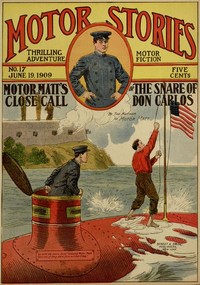
This digital edition of Motor Matt's Close Call; or, The Snare of Don Carlos — Reading Companion is described by source-level measurements including 36,387 words, 2 hr 39 min estimated reading time, and 4 detected text sections.
The text analysis averages about 13.7 words per sentence, while the detected sections provide another way to judge how the source is divided.
Project Gutenberg metadata also associates the work with “Adventure stories,” connecting these edition facts with the source record’s subject description.
Explore this collection
These alternatives are selected using recorded categories and estimated reading time.
About 159 minutes
Childrens Adventures
36,520 recorded words. 0 minutes difference from this book's estimate.
View Gutenberg source #47788About 160 minutes
Childrens Adventures
36,632 recorded words. 1 minutes difference from this book's estimate.
View Gutenberg source #49644About 156 minutes
Childrens Adventures
35,810 recorded words. 3 minutes difference from this book's estimate.
View Gutenberg source #44824Search stored excerpts and compare books → Choose by your preferences →
Choices use stored catalog measurements. Estimates vary with reading speed. A shared category is a catalog label, not a claim that two books have the same argument or literary quality.
Search reads excerpt text stored with this catalog and links to its associated Gutenberg record. The connection is stored in the site database; this tool does not recheck that every excerpt is word-for-word identical to that external record. Excerpt search does not cover every chapter and does not verify historical publication dates.
Catalog snapshot checked: 2026-09-25. Coverage: 98 public books, 98 available source excerpts.
Calculated from edition completeness, EPUB availability, text structure and catalogue metadata. Not a user rating.
Total of 100 points, scaled to a 2.5-5.0 range. Editions with an empty description or a missing EPUB file are not scored.
Public-domain source text
The source text is kept in the dedicated reader, separate from this catalogue record and its commentary.
Stanley R. Matthews opens Motor Matt's Close Call with a serenade—Carl Pretzel, the German sidekick, singing under a window—but the story quickly submerges into a world of whispered commands, bound captives, and the claustrophobic confines of a submarine. The author’s diction favors short, imperative sentences: “Get ropes, boys,” “Stand ready,” “Ready!” This clipped syntax mirrors the urgency of a covert operation, where every word must count. Matthews also relies on repeated physical cues—a lifted finger, a drawn weapon, a “strangling grip”—to telegraph danger without lengthy exposition. The result is a narrative that moves as fast as its hero’s motorboats, driven by action rather than introspection.
Matthews builds tension through a vocabulary of restraint. In the excerpt, characters speak in hushed tones: “don’t make a noise—please,” “we can’t use firearms, for they make too much noise.” The word “whispered” appears repeatedly, reinforcing the need for stealth. The author also uses gestures as shorthand for complex plans: “Matt lifted a warning finger,” “motioned for Dick and Clackett to come closer.” These non-verbal cues replace longer explanations, keeping the pace brisk. The dialogue itself is functional—characters state facts (“Pedro is bound and gagged”) or give orders (“Stand ready for him”). There is little banter or reflection; every line advances the plot. This economy of language mirrors the submarine’s cramped quarters, where space and time are both limited.
The author structures the capture sequence as a series of mechanical steps. First, Ysabel volunteers to lure the guards one at a time. Then Matt assigns roles: “Get ropes, boys… stand ready for some swift and noiseless work.” The plan is executed with precision—Fingal descends the ladder, Matt springs at his throat, and the others seize his arms. Matthews emphasizes the physicality of the struggle: “Fingal was a big fellow,” “crushing embrace of his huge arms.” Yet the focus remains on the process, not the emotion. The word “maneuvre” (misspelled as “maneuvre” in the text) signals that this is a tactical operation, not a brawl. The author even notes the angle of Fingal’s gaze (“kept his gaze upward”) to explain why the ambush succeeds. This attention to spatial detail gives the action a choreographed feel.
Several physical objects recur as plot devices. Ropes are used to bind Pedro and later prepared for the card players. The torpedo tube serves as an escape route for Gaines, who “got out through the torpedo tube, half an hour ago.” The bolt on the torpedo-room door is mentioned as easily slid open. These mechanical details ground the adventure in tangible constraints. Matthews also uses the submarine’s layout—ladder, conning tower, periscope room—to create a three-dimensional stage. Characters move “forward,” “aft,” and “up the ladder,” reinforcing the vertical and horizontal axes of the vessel. The author does not explain how a submarine works; instead, he treats it as a familiar environment, trusting readers to follow the spatial logic.
Ysabel Sixty stands out for her active role in the rescue. She does not wait to be saved; she proposes the decoy plan: “I’ll go up the ladder… and say that Pedro wants one of them.” She also provides the revolver, handing it to Matt with the words “Here is Pedro’s revolver—take it.” Her dialogue is direct and unflinching: “This is only the beginning, Motor Matt.” Matthews describes her with “cheeks flushed with excitement and her eyes bright as stars,” but her actions are what define her. She “glided to the ladder” and later “drew away fearfully” at Fingal’s arrival, yet she does not flee. The author balances her fear with competence, making her a credible ally rather than a damsel in distress. Her loyalty is stated in the character list, but the excerpt shows it through deeds.
Readers approaching Motor Matt’s Close Call should attend to how Matthews uses physical space and constrained dialogue to generate suspense. The submarine setting is not merely a backdrop but an active constraint on the characters’ options. Notice how often the author specifies who is standing where, who can see whom, and what objects are at hand. These details are not filler; they are the machinery of the plot. The story rewards close attention to its mechanics.
I’ve often thought Motor Matt’s Close Call shares a breathless pulse with the old war chronicle, With the Allies to Pekin: A Tale of the Relief of the Legations — Reading Companion — both trusting the short, half-spoken sentence and the sudden scuffle to tell what words cannot. Each page feels like a held breath, released only when the danger passes.
Your answers remain private and are stored only in this browser.









