About 159 minutes
Motor Matt's Close Call; or, The Snare of Don Carlos — Reading Companion
Childrens Adventures
36,387 recorded words. 0 minutes difference from this book's estimate.
View Gutenberg source #49695
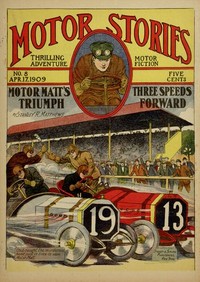
For Motor Matt's Triumph; or, Three Speeds Forward — Themes and Context, the stored edition analysis reports 36,520 words, 2 hr 39 min estimated reading time, and 4 detected text sections.
The text analysis averages about 13.5 words per sentence, while the detected sections provide another way to judge how the source is divided.
Project Gutenberg metadata also associates the work with “Adventure stories,” connecting these edition facts with the source record’s subject description.
Explore this collection
These alternatives are selected using recorded categories and estimated reading time.
About 159 minutes
Childrens Adventures
36,387 recorded words. 0 minutes difference from this book's estimate.
View Gutenberg source #49695About 160 minutes
Childrens Adventures
36,632 recorded words. 1 minutes difference from this book's estimate.
View Gutenberg source #49644About 156 minutes
Childrens Adventures
35,810 recorded words. 3 minutes difference from this book's estimate.
View Gutenberg source #44824Search stored excerpts and compare books → Choose by your preferences →
Choices use stored catalog measurements. Estimates vary with reading speed. A shared category is a catalog label, not a claim that two books have the same argument or literary quality.
Search reads excerpt text stored with this catalog and links to its associated Gutenberg record. The connection is stored in the site database; this tool does not recheck that every excerpt is word-for-word identical to that external record. Excerpt search does not cover every chapter and does not verify historical publication dates.
Catalog snapshot checked: 2026-09-25. Coverage: 98 public books, 98 available source excerpts.
Calculated from edition completeness, EPUB availability, text structure and catalogue metadata. Not a user rating.
Total of 100 points, scaled to a 2.5-5.0 range. Editions with an empty description or a missing EPUB file are not scored.
Public-domain source text
The source text is kept in the dedicated reader, separate from this catalogue record and its commentary.
The story opens with a burst of comic dialect as Carl Pretzel, a German-accented character, protests an attack in a dark Denver street: “Vat's der madder mit you? Ach, du lieber! Vaid a minid!” The abrupt shift from his clamor to a sudden hush sets a pattern of interrupted action that recurs throughout the excerpts. The narrative quickly establishes a cast of characters including Matt King, nicknamed “Mile-a-minute Matt,” his chum Chub McReady, and a roster of antagonists from the Motor Drivers Association. The setting—a cross-street at nine o'clock—and the mention of “White-caps” in the first chapter title hint at vigilante-style threats, though the excerpts do not reveal the full nature of this group.
Carl Pretzel’s speech is the most distinctive stylistic feature in the excerpts. His German-inflected English, rendered phonetically, produces lines like “Hoop-a-la! Oof it vas a fighdt, den ged avay, a gouple oof tozen oof you, und come ad me vone py each.” This comic dialect contrasts sharply with the more standard narration and dialogue of other characters, such as Chub McReady or the night clerk. The effect is both humorous and disorienting, as Carl’s outbursts often punctuate moments of tension. For instance, after Matt’s disappearance, Carl exclaims, “Vouldn't dot knock you shlap-sitet?” The dialect serves as a marker of Carl’s foreignness and his role as a source of comic relief, but it also adds a layer of verbal energy to the investigation scenes. The author uses this contrast to vary the tone, moving from slapstick to suspense without fully committing to either.
The excerpts build suspicion through a series of small, telling details. When Carl and Chub confront Slocum, he throws a newspaper over the table—an “odd move” that the narration flags as suspicious. Earlier, the night clerk reports that Matt left at midnight “and took his grip with him,” but adds that Matt “didn't seem to know what he was doing” and “stared at me.” These observations create a puzzle: Matt’s behavior is out of character, and the clerk’s hesitation (“I didn't know whether I ought to tell you or not”) suggests that the racing world is full of comings and goings that blur the line between normal and suspicious. The story relies on such ambiguous clues rather than direct evidence. Slocum’s drawing of a revolver when grabbed by Carl is another escalation, but his explanation—that he was merely defending himself—leaves the reader uncertain. The narrative withholds full confirmation of guilt, instead letting the characters’ reactions and the accumulation of odd incidents drive the investigation.
The excerpts depict a racing milieu where trust is scarce and rivalries run deep. The Motor Drivers Association includes members “ready to go to any length to keep Motor Matt out of the great race for the Borden Cup.” Matt’s disappearance occurs just before the race, and the night clerk’s comment that “these racing folks are coming and going all the time, and, for the most part, they're a queer lot” reinforces the idea that the racing circuit is a transient, morally ambiguous space. The character Trueman, for whom Matt is driving, is introduced only as a name to consult. The pressure of the upcoming race amplifies every odd event: a missing pitcher of water, a bellboy’s errand, a newspaper thrown over a table. The story uses the race as a deadline that raises the stakes for every clue. The excerpts do not reveal the race’s outcome, but the title “Motor Matt's Triumph” suggests that the hero will overcome these obstacles, though the path remains unclear from the provided text.
Readers should pay attention to how the story balances its two modes: the broad comedy of Carl’s dialect and the tighter, clue-driven suspense of the investigation. The excerpts suggest that the narrative moves between these registers without fully merging them. The title’s phrase “Three Speeds Forward” may hint at a mechanical or narrative principle of acceleration, but the excerpts do not confirm this. Approach the book as a period adventure that uses its dime-novel format to deliver quick shifts in tone and action.
Reading about Carl Pretzel’s worried stammer before the Borden Cup made me remember how quiet the Comet’s hangar felt in that later race. The same mechanic, but older somehow. I suppose there is a melancholy thread between them, a kind of fading innocence. I found myself flipping back to Motor Matt's Race; or, The Last Flight of the Comet — A Reader’s Guide afterwards, just to sit with that feeling a little longer.
Save your reaction, strongest insight, and memorable passage.









