
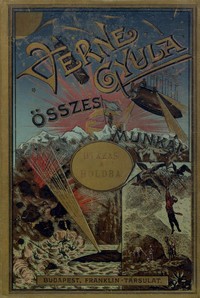
Utazás a Holdba kilenczvenhét óra és husz percz alatt by Jules Verne
Jules Verne's From the Earth to the Moon is a story born from pure, unchecked enthusiasm. After the American Civil War ends, the members of the Baltimore Gun Club—a group of brilliant, bored artillery experts—are desperate for a new project. Their president, the fiery Impey Barbicane, proposes the ultimate challenge: build a cannon so powerful it can fire a projectile to the moon.
The Story
The book is split into two thrilling parts. First, we get the world's greatest fundraising and engineering montage. Barbicane and his club calculate everything: the exact size of the cannon, the type of metal, the mind-boggling amount of gunpowder needed. They raise money globally, pick a launch site in Florida (Verne predicted Cape Canaveral!), and deal with public doubt and a rival who tries to sabotage the whole thing. The second part kicks in when a daring French adventurer, Michel Ardan, shows up. He doesn't just want to send a metal bullet to the moon—he volunteers to ride inside it! He convinces Barbicane and his arch-rival, Captain Nicholl, to join him in a specially designed, padded projectile. The story builds with incredible tension right up to the monumental launch.
Why You Should Read It
What amazed me isn't the fantasy, but the science. Verne did his homework. His calculations for weight, velocity, and even the Florida launch site are eerily close to reality. But the real magic is in the characters. These aren't modern, cautious astronauts. They're Victorian-era geniuses and thrill-seekers, debating the merits of aluminum and arguing about whether to bring dogs on the trip. Their boldness is infectious. You're constantly thinking, "This is insane," while also rooting for them completely. It's a joyful celebration of human 'what if?' energy.
Final Verdict
This book is perfect for anyone who loves the history of science, big ideas, or stories about passionate people doing the seemingly impossible. If you enjoy shows like The Right Stuff but want it with more top hats and less government oversight, you'll adore this. It's not a deep character study—it's a propulsive, clever, and often funny adventure that reminds us why we look up at the sky and dream in the first place.
This historical work is free of copyright protections. It serves as a testament to our shared literary heritage.
Barbara Wilson
6 months agoFast paced, good book.
David Moore
3 weeks agoAfter hearing about this author multiple times, it challenges the reader's perspective in an intellectual way. Truly inspiring.
Aiden Wilson
1 year agoGood quality content.
Ashley Perez
1 year agoI was skeptical at first, but the depth of research presented here is truly commendable. Definitely a 5-star read.

Paul Lee
4 months agoI was skeptical at first, but the plot twists are genuinely surprising. Absolutely essential reading.