About 234 minutes
Linda Carlton's Ocean Flight — Key Ideas to Explore
Childrens Adventures
53,661 recorded words. 0 minutes difference from this book's estimate.
View Gutenberg source #48478
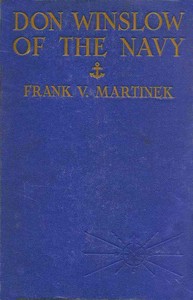
This digital edition of Don Winslow of the Navy — Reading Companion is described by source-level measurements including 53,691 words, 3 hr 54 min estimated reading time, and 31 detected text sections.
The text analysis averages about 13.1 words per sentence, while the detected sections provide another way to judge how the source is divided.
Project Gutenberg metadata also associates the work with “Adventure stories,” connecting these edition facts with the source record’s subject description.
Explore this collection
These alternatives are selected using recorded categories and estimated reading time.
About 234 minutes
Childrens Adventures
53,661 recorded words. 0 minutes difference from this book's estimate.
View Gutenberg source #48478About 234 minutes
Childrens Adventures
53,622 recorded words. 0 minutes difference from this book's estimate.
View Gutenberg source #50260About 235 minutes
Childrens Adventures
53,981 recorded words. 1 minutes difference from this book's estimate.
View Gutenberg source #51979Search stored excerpts and compare books → Choose by your preferences →
Choices use stored catalog measurements. Estimates vary with reading speed. A shared category is a catalog label, not a claim that two books have the same argument or literary quality.
Search reads excerpt text stored with this catalog and links to its associated Gutenberg record. The connection is stored in the site database; this tool does not recheck that every excerpt is word-for-word identical to that external record. Excerpt search does not cover every chapter and does not verify historical publication dates.
Catalog snapshot checked: 2026-09-25. Coverage: 98 public books, 98 available source excerpts.
Calculated from edition completeness, EPUB availability, text structure and catalogue metadata. Not a user rating.
Total of 100 points, scaled to a 2.5-5.0 range. Editions with an empty description or a missing EPUB file are not scored.
Public-domain source text
The source text is kept in the dedicated reader, separate from this catalogue record and its commentary.
The first chapter, “Bombed!,” opens not with a naval engagement but with two men and a girl stranded on a jungle-bordered cove in Haiti. The girl is Mercedes Colby, daughter of a retired Navy Admiral, and her companions are Don Winslow and Lieutenant “Red” Pennington, both in torn, mudstained clothing. The narrative immediately signals that these characters have been through hardship, describing their condition as “beachcombers’ rags” and noting that Don Winslow has “half a shirt tucked into the remnant of once-white trousers.”
The scene establishes a pattern of mixing domestic details with high-stakes espionage. Mercedes’s appearance is contrasted with a society columnist’s memory of her coiffure at a Washington ball, and the text explicitly states that “ordinary duties had never been the lot of Don Winslow” since his appointment to Naval Intelligence. The enemy is a “vast international crime ring” aiming to plunge the world into war, and the operative must be “an expert with every type of weapon.”
The catalog subjects list “Adventure stories,” “Sailors -- Juvenile fiction,” and “United States. Navy -- Juvenile fiction,” but the excerpts reveal a story that is far more espionage thriller than seafaring adventure. The opening chapter takes place on a beach, not a ship, and the characters are stranded, not on duty. The only naval element in the first chapter is the characters’ ranks and their assignment to the Naval Intelligence Service. The actual Navy—ships, regulations, routine—is mentioned only to be subverted: “nothing in the book of Navy Regulations (which covers everything) decrees that even a lieutenant must tackle the Haitian jungle barefooted.”
The narrative focuses on secret missions, wiretapping concerns, and a private radio beam transmitter. The villain is not a foreign navy but a spymaster called “the Scorpion.” The text’s emphasis on international crime rings and espionage aligns more with the “adventure-fiction” secondary topic than with the naval subject headings. Readers expecting a traditional Navy story with battles at sea will instead find a land-based spy plot with occasional maritime references.
A striking detail in the excerpts is the repeated attention to secure communication. When Don Winslow makes a phone call to Washington, the text specifies that he is sitting in a “soundproofed booth” connected to a “powerful radio beam transmitter.” Mercedes worries about wire tapping and radiophone interception, and Michael Splendor explains the precautions in detail, including the low probability of an airplane eavesdropping on the beam.
This motif appears again when Splendor mentions that the radioman among the captives “is only too anxious to talk.” The narrative treats communication as both a vulnerability and a weapon. The soundproof booth, the private radio room, and the beam transmitter are not just set dressing; they are plot devices that enable the heroes to operate securely. This technical specificity is unusual for a juvenile adventure and suggests that the author, Frank V. Martinek, had some familiarity with radio technology or took care to research it.
The excerpts use clothing and physical condition as shorthand for character and situation. Mercedes Colby is introduced through her “stout whipcord breeches” and “mass of wind blown curls,” with her face bearing “traces of weariness and jungle dirt.” This is immediately contrasted with a society columnist’s memory of her at a Washington ball, establishing her as a character who has moved from high society to rough adventure.
Don Winslow and Red Pennington are described in terms of their ragged uniforms: “beachcombers’ rags,” “half a shirt,” “remnant of once-white trousers.” The text emphasizes their “blistered skin and bleeding feet” as evidence of their dedication. Even the minor character Michael Splendor is introduced in a wheelchair, a physical detail that sets him apart from the able-bodied heroes. These descriptions serve to quickly convey the characters’ circumstances and the story’s tone without lengthy exposition.
The excerpts from Don Winslow of the Navy show a work that blends juvenile adventure with espionage tropes, set largely on land rather than at sea. Readers should note that the catalog subjects may overemphasize the naval aspect; the story’s core is a spy thriller with a global crime ring. The text’s attention to communication technology and physical detail provides a concrete, period-specific texture. Approach this as a 1940s action serial rather than a technical naval manual.
Reading this, I remembered being ten and hearing the jungle’s static crackle on an old radio, certain a villain hid behind every palm. That same wide-eyed alertness came back with The Boy Scouts with the Red Cross — A Reader’s Guide, where adventure softened into something quieter—helping hands instead of hidden guns. Both felt like doorways to worlds I could almost touch.
A brief reflection can help important ideas stay with you longer.









