About 164 minutes
Motor Matt's Clue; or, The Phantom Auto — Key Ideas to Explore
Childrens Adventures
37,663 recorded words. 1 minutes difference from this book's estimate.
View Gutenberg source #47625
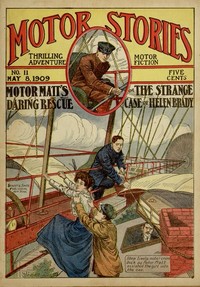
Before opening Motor Matt's Daring Rescue; or, The Strange Case of Helen Brady — Background and Themes, the edition data offers a quick orientation: 37,911 words, 2 hr 45 min estimated reading time, and 4 detected text sections.
The text analysis averages about 14.5 words per sentence, while the detected sections provide another way to judge how the source is divided.
Project Gutenberg metadata also associates the work with “Adventure stories,” connecting these edition facts with the source record’s subject description.
Explore this collection
These alternatives are selected using recorded categories and estimated reading time.
About 164 minutes
Childrens Adventures
37,663 recorded words. 1 minutes difference from this book's estimate.
View Gutenberg source #47625About 160 minutes
Childrens Adventures
36,632 recorded words. 5 minutes difference from this book's estimate.
View Gutenberg source #49644About 159 minutes
Childrens Adventures
36,520 recorded words. 6 minutes difference from this book's estimate.
View Gutenberg source #47788Search stored excerpts and compare books → Choose by your preferences →
Choices use stored catalog measurements. Estimates vary with reading speed. A shared category is a catalog label, not a claim that two books have the same argument or literary quality.
Search reads excerpt text stored with this catalog and links to its associated Gutenberg record. The connection is stored in the site database; this tool does not recheck that every excerpt is word-for-word identical to that external record. Excerpt search does not cover every chapter and does not verify historical publication dates.
Catalog snapshot checked: 2026-09-25. Coverage: 98 public books, 98 available source excerpts.
Calculated from edition completeness, EPUB availability, text structure and catalogue metadata. Not a user rating.
Total of 100 points, scaled to a 2.5-5.0 range. Editions with an empty description or a missing EPUB file are not scored.
Public-domain source text
The source text is kept in the dedicated reader, separate from this catalogue record and its commentary.
The opening chapter of Motor Matt's Daring Rescue immediately establishes a pattern of clipped, functional dialogue—'Your name King?' 'Yes.'—that mirrors the story's emphasis on rapid, mechanical action. The air ship Hawk is not merely a vehicle but a character in its own right, described with precise attention to its fuel levels, load capacity, and steering. Yet the narrative repeatedly undercuts the craft's technological promise with human fallibility: officers Sanders and Burton express fear of the air, and even the reliable Matt must 'give my whole attention to the engine.' This tension between mechanical mastery and bodily vulnerability runs through the excerpts.
The excerpts contrast the Hawk's elevated view with the grounded anxieties of the police. Officer Sanders gasps as the car careens and wishes to be low enough to 'tumble out if anything slips a cog.' Harris, by contrast, trusts Matt completely: 'No cog ever slips… with King in charge.' This split reflects a broader structural pattern: the air ship enables a daring rescue plan, but the narrative repeatedly returns to the ground, where telegraphing, carriage rides, and foot pursuit occur. The story seems to ask whether technology or traditional policing will prevail, though the excerpts do not reveal the outcome.
Convicted criminal Hector Brady is introduced as a figure of unstable loyalties. He breaks prison to 'wreak vengeance' on former associates Pete and Whipple, yet later cooperates with the police, walking back into the 'pen' voluntarily. Harris notes that Brady would not have returned 'if he hadn't been so hungry to land Pete and Whipple.' This motive—vengeance overriding self-preservation—creates a peculiar alliance between lawman and outlaw. The excerpts show Brady physically moving between the carriage (with officers) and the air ship (with Matt), embodying the story's central ambiguity about who can be trusted.
Recurring details of weight, capacity, and equilibrium suggest a thematic concern with limits. The Hawk is burdened 'as great as she could carry,' the car is 'somewhat crowded,' and Matt fills the tank 'full up' from reserve supplies. Even the dialogue carries this motif: Sanders fears the car careening, and the air ship's turn at right angles is executed with care to avoid detection. These physical constraints mirror the story's moral and logistical balancing acts—between speed and stealth, between Brady's dual roles, between the promise of flight and the drag of the earth.
Readers attentive to the excerpts will notice that the story's title promises a rescue, but the text dwells more on preparation, negotiation, and the mechanics of flight than on the rescue itself. The incomplete excerpts leave unclear whether Helen Brady is ever actually saved, or how the air ship's role resolves. This note encourages a reading that watches for how the story manages its competing pressures—technological, criminal, and procedural—without assuming a tidy conclusion.
There’s a particular balance in Motor Matt’s Daring Rescue—the airship above, the officers below, Hector’s loyalties swaying—that lingered with me long after closing the pages. It reminded me, oddly, of another quiet afternoon spent with The Flying Machine Boys in the Wilds; Or, The Mystery of the Andes — Themes and Context, where the mountains themselves seem to hold that same fragile equilibrium between marvel and menace.
Your answers remain private and are stored only in this browser.









