About 143 minutes
The Boy Scouts with the Red Cross — A Reader’s Guide
Childrens Adventures
32,685 recorded words. 3 minutes difference from this book's estimate.
View Gutenberg source #49799
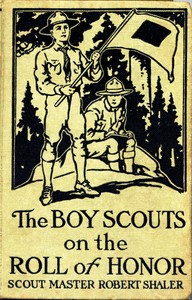
This digital edition of The Boy Scouts on the Roll of Honor — Inside the Classic is described by source-level measurements including 33,449 words, 2 hr 26 min estimated reading time, and 5 detected text sections.
The text analysis averages about 21.3 words per sentence, while the detected sections provide another way to judge how the source is divided.
Project Gutenberg metadata also associates the work with “Mystery and detective stories,” connecting these edition facts with the source record’s subject description.
Explore this collection
These alternatives are selected using recorded categories and estimated reading time.
About 143 minutes
Childrens Adventures
32,685 recorded words. 3 minutes difference from this book's estimate.
View Gutenberg source #49799About 142 minutes
Childrens Adventures
32,565 recorded words. 4 minutes difference from this book's estimate.
View Gutenberg source #52143About 141 minutes
Childrens Adventures
32,237 recorded words. 5 minutes difference from this book's estimate.
View Gutenberg source #52130Search stored excerpts and compare books → Choose by your preferences →
Choices use stored catalog measurements. Estimates vary with reading speed. A shared category is a catalog label, not a claim that two books have the same argument or literary quality.
Search reads excerpt text stored with this catalog and links to its associated Gutenberg record. The connection is stored in the site database; this tool does not recheck that every excerpt is word-for-word identical to that external record. Excerpt search does not cover every chapter and does not verify historical publication dates.
Catalog snapshot checked: 2026-09-25. Coverage: 98 public books, 98 available source excerpts.
Calculated from edition completeness, EPUB availability, text structure and catalogue metadata. Not a user rating.
Total of 100 points, scaled to a 2.5-5.0 range. Editions with an empty description or a missing EPUB file are not scored.
Public-domain source text
The source text is kept in the dedicated reader, separate from this catalogue record and its commentary.
Robert Shaler opens The Boy Scouts on the Roll of Honor with a burst of overlapping dialogue that immediately establishes the scouts’ camaraderie and their charitable mission: gathering nuts for an orphan asylum. The first chapter’s title, “The Nut Gatherers,” signals a deceptively simple premise, but the narrative voice quickly reveals a pattern of understated heroism. Hugh Hardin, the assistant scout master, is introduced through the admiring remarks of his peers—a technique that lets Shaler build reputation without direct exposition. The prose moves at a brisk, conversational pace, punctuated by exclamations and dashes, before shifting into more measured, descriptive passages as the story progresses toward a blizzard-bound rescue.
From the first line—“It’s turned out to be a nutting trip worth while, fellows!”—Shaler uses dialogue to define character and control tempo. The scouts speak in overlapping, enthusiastic bursts, often completing each other’s thoughts. This technique creates a sense of collective identity: individual voices blend into a group dynamic. When Hugh interrupts the praise with “Oh, come, change the subject, please! It is getting to be a regular chestnut with me,” his modesty is shown through a pun, not narration. Later, during the storm rescue, dialogue becomes terse and functional. Hugh shouts instructions—“You’re to lean on two of us”—and the sentences shorten to match the urgency. Shaler rarely uses dialogue tags beyond “said” or “demanded,” letting the words carry the emotional weight. The contrast between the chatty opening and the clipped exchanges in the blizzard marks a clear shift in pace.
Shaler’s handling of the blizzard is the book’s most effective pacing device. Early chapters move at a leisurely, episodic rhythm, with descriptions of nut gathering and camp setup. But once the storm arrives, the prose tightens. Sentences become shorter, dominated by action verbs: “Slowly they moved along, down the slight grade, and facing the worst of the still bitter wind.” The narrative zeroes in on physical sensations—cold, wind, exhaustion—and the characters’ internal focus narrows to the immediate goal of reaching shelter. Shaler also uses the storm to compress time: events that might have taken hours are condensed into a few paragraphs of tense, step-by-step movement. The weather is not merely backdrop but an active force that dictates the story’s rhythm, forcing the scouts into reactive, survival-mode decision-making.
Though the narration is third-person, Shaler frequently dips into the perspective of a single character, most often Gus. In Chapter IX, “Gus in the Lime-light,” the narrative follows Gus’s anxiety as he hovers “close behind the others, trying to figure out how his brother was going to take it.” This focalization allows the reader to experience the rescue through a lens of personal stakes—Gus’s dread and hope—while the omniscient voice still supplies broader context, such as the approaching blizzard. Shaler also uses collective focalization: phrases like “they had managed to reach the creek” blend the group’s experience. The voice remains consistently formal in description (“a spasm of supreme joy flitted through the heart of Gus”) but shifts to colloquial directness in dialogue. This alternation between detached observation and intimate feeling gives the prose a layered texture, even when the plot follows a straightforward rescue arc.
Readers attentive to narrative craft will notice how Shaler balances the series’ formulaic structure—a scout proving his worth—with genuine stylistic choices. The dialogue-driven opening, the storm’s accelerating effect on prose, and the careful focalization around Gus all reward close reading. This edition preserves the original 1916 text, including its period-specific idioms and pacing, which may feel slower to modern audiences but offer a clear window into early twentieth-century adventure writing for boys.
There’s something about the storm in Shaler’s lumber-camp rescue that lingers—the way the boys’ hurried shouts blur into the wind’s noise. I find myself thinking of that same breathless quiet when reading Nancy Pembroke in Nova Scotia — A Closer Reading, where the sea feels just as close and just as indifferent, a distant cousin to those old pines. Both books hold that ache of running toward something you can’t quite see.
Save your reaction, strongest insight, and memorable passage.









