
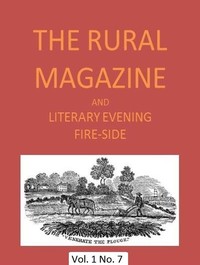
The Rural Magazine, and Literary Evening Fire-Side, Vol. 1 No. 07 (1820) by Various
Let's be clear from the start: this isn't a novel. The Rural Magazine, and Literary Evening Fire-Side is a monthly periodical, a miscellany designed for families in the countryside. Think of it as a blog, a newspaper, a how-to manual, and a book of poetry all stitched together and mailed to your door. This particular issue from 1820 offers a slice of life so specific it feels almost fictional.
The Story
There's no single plot. Instead, you turn the page and enter different worlds. One article seriously discusses the best methods for draining a swampy field. The next might be a melancholic poem about a fading flower. Then you'll find a fictionalized dialogue promoting moral integrity, followed by an account of a traveler's observations in a foreign land. It jumps from practical soil science to sentimental fiction without a blink. The through-line is the magazine's mission: to provide 'useful knowledge' and 'rational amusement' to a rural readership. The 'story' is the collective effort of these anonymous writers to educate, elevate, and entertain an entire community, one fireside at a time.
Why You Should Read It
I love this because it's history without the filter. Textbooks tell us about the Industrial Revolution and political debates. This shows you what a farmer might have read after a long day's work. The concerns are immediate—how to save a crop, how to be a good neighbor, how to find beauty in a simple life. The prose can be formal, but the intentions are direct. You see the values of the era in action: self-reliance, improvement, and a deep belief in the power of reading. It’s also full of charming quirks, like earnest advice that now seems obvious or poetic language we simply don't use anymore. It makes the past feel populated by real, thinking people.
Final Verdict
This is a niche read, but a rewarding one. It's perfect for history buffs who want to move beyond dates and battles, for writers seeking authentic period voice, or for anyone with a curiosity about the rhythms of everyday life in early America. If you enjoy browsing old newspapers or digging through archival letters, you'll find a similar thrill here. It's not a page-turner in the modern sense, but as a quiet, thoughtful visit to another time, it’s completely absorbing.
You are viewing a work that belongs to the global public domain. Access is open to everyone around the world.
Joseph Gonzalez
6 months agoI've been looking for a reliable source on this topic, and the concise summaries at the end of each section are a lifesaver. Highly recommended for those seeking credible information.
Patricia Martinez
10 months agoHaving explored several resources on this, I find that the clarity of the writing makes even the most dense sections readable. Highly recommended for those seeking credible information.
Elizabeth Hernandez
2 years agoUnlike many other resources I've purchased before, the nuanced approach to the central theme was better than I expected. Definitely a five-star contribution to the field.
Jennifer Martinez
11 months agoI particularly value the technical accuracy maintained throughout.


David Martin
6 months agoFrom a researcher's perspective, the clarity of the writing makes even the most dense sections readable. I’ll definitely be revisiting some of these chapters again soon.