Is It Correct to Say ‘reply me’?
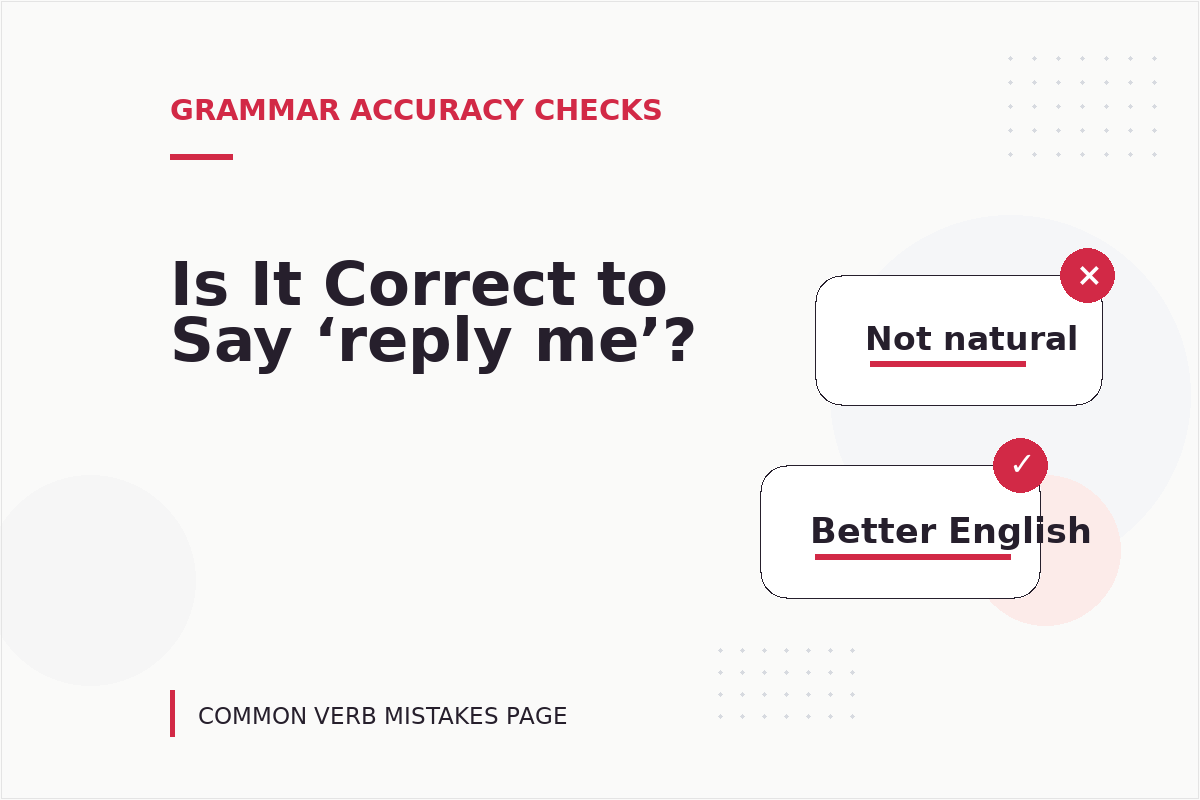
No, it is not correct to say “reply me” in standard English. The verb “reply” requires the preposition “to” before an object. The correct phrase is “reply to me.” Saying “reply me” is a common mistake, especially among learners whose first language allows a direct object after a similar verb. This guide explains why “reply me” is wrong, how to use “reply” correctly, and what to say instead in emails, conversations, and formal writing.
Quick Answer: Why “Reply Me” Is Incorrect
“Reply” is an intransitive verb in most contexts, meaning it cannot take a direct object. You cannot “reply someone.” You must say “reply to someone.” Compare this with the verb “answer,” which is transitive and can take a direct object: “answer me” is correct, but “reply me” is not. Always use “reply to” when mentioning the person you are responding to.
Understanding the Grammar of “Reply”
The verb “reply” means to give an answer or respond. In English, it is almost always followed by the preposition “to” when the recipient is named. This is a fixed pattern. Here is the basic structure:
- Subject + reply + to + person/thing
- Subject + reply + that + clause
- Subject + reply + with + something
For example:
- Correct: Please reply to me by Friday.
- Incorrect: Please reply me by Friday.
- Correct: She replied to his question.
- Incorrect: She replied his question.
This rule applies in both formal and informal English. Even in casual conversation, native speakers do not say “reply me.” They might say “get back to me” or “let me know,” but never “reply me.”
Comparison Table: “Reply” vs. “Answer” vs. “Respond”
| Verb | Correct Pattern | Example | Common Mistake |
|---|---|---|---|
| Reply | reply to + person | Please reply to me. | Please reply me. |
| Answer | answer + person (direct object) | Please answer me. | Please answer to me. (rare but awkward) |
| Respond | respond to + person | Please respond to me. | Please respond me. |
Notice that “answer” is the only verb in this group that can take a direct object without a preposition. “Reply” and “respond” both require “to.”
Natural Examples of Correct Usage
Here are real-life examples showing how native speakers use “reply” correctly in different situations.
In Email
- Correct: I look forward to your reply. (noun form)
- Correct: Please reply to my email at your earliest convenience.
- Correct: She replied to all the attendees.
- Incorrect: She replied all the attendees.
In Conversation
- Correct: He didn’t reply to my text message.
- Correct: Why didn’t you reply to me when I called?
- Incorrect: He didn’t reply my text message.
- Incorrect: Why didn’t you reply me?
In Formal Writing
- Correct: The committee will reply to your application within two weeks.
- Correct: We kindly ask that you reply to this invitation by Monday.
- Incorrect: The committee will reply your application.
Common Mistakes with “Reply”
Learners often make these errors. Study them carefully to avoid them in your own writing and speaking.
- “Reply me” instead of “reply to me”
This is the most frequent mistake. It happens because in many languages, such as Hindi, Spanish, or Arabic, the verb “reply” can take a direct object. In English, it cannot. - “Reply back”
Some learners add “back” after “reply,” thinking it adds emphasis. However, “reply” already means to respond, so “reply back” is redundant. Use “reply” alone or “write back.” - “Reply for” instead of “reply to”
You reply to a person or a message, not for them. For example: “I will reply to your question” (not “reply for your question”). - Using “reply” as a transitive verb in questions
Example: “Who did you reply?” This is incorrect. The correct form is “Who did you reply to?”
Better Alternatives and When to Use Them
If you are unsure about using “reply to,” you can often replace it with a different verb. Here are some practical alternatives for different contexts.
For Emails
- Respond to – Slightly more formal than “reply.” Example: “Please respond to my email.”
- Get back to – Informal and common in workplace chat. Example: “I’ll get back to you tomorrow.”
- Write back – Natural for personal emails. Example: “Write back when you have time.”
For Conversations
- Answer – Direct and simple. Example: “Can you answer me?”
- Let me know – Friendly and open. Example: “Let me know what you think.”
- Give me an answer – Clear and direct. Example: “Please give me an answer by noon.”
For Formal or Business Contexts
- Acknowledge – Used when you need confirmation. Example: “Please acknowledge receipt of this message.”
- Provide a response – Very formal. Example: “Kindly provide a response to the inquiry.”
When to Use “Reply” (and When Not To)
Use “reply” when you want to sound neutral or slightly formal. It works well in both written and spoken English, but it is less common in very casual speech. In everyday conversation, native speakers often prefer “answer,” “get back to,” or “let me know.”
For example:
- Casual: “Hey, did you get my text? Let me know.”
- Neutral: “Please reply to my message when you can.”
- Formal: “We await your reply to our proposal.”
If you are writing a quick text to a friend, “reply” might sound a bit stiff. Use “answer” or “text back” instead. But in professional emails, “reply” is perfectly fine as long as you use it correctly with “to.”
Mini Practice: Check Your Understanding
Test yourself with these four questions. Choose the correct option in each sentence.
- Please (reply / reply to) me as soon as possible.
- She didn’t (answer / reply) my question.
- I will (reply / reply back) to your email tonight.
- Who did you (reply to / reply) in the meeting?
Answers:
- reply to
- answer (or “reply to” if you add “to”)
- reply (remove “back”)
- reply to
Frequently Asked Questions
1. Is “reply me” ever correct in any dialect of English?
No. “Reply me” is not considered correct in any standard variety of English, including American, British, Australian, or Indian English. Some non-native speakers use it, but it is always a mistake. Stick with “reply to me.”
2. Can I say “reply my email”?
No. You must say “reply to my email.” The same rule applies: “reply” needs “to” before the object. However, you can say “answer my email” because “answer” is transitive.
3. What is the difference between “reply” and “respond”?
Both verbs mean the same thing and follow the same grammar pattern: “reply to” and “respond to.” “Respond” is slightly more formal and is often used in official or technical contexts. “Reply” is more common in everyday writing and speech.
4. Is “reply” a noun too?
Yes. As a noun, “reply” does not need a preposition. For example: “I am waiting for your reply.” This is correct. The noun form is very common in emails and letters. You can also say “in reply to” as a phrase: “In reply to your question, here are the details.”
Final Tip for Learners
If you catch yourself about to write or say “reply me,” stop and add “to.” It is a small change that makes a big difference in your English accuracy. Practice by writing a few sentences today: “I will reply to my boss,” “She replied to the invitation,” “They never reply to comments.” With consistent practice, the correct pattern will become automatic.
For more help with similar grammar issues, explore our Grammar Accuracy Checks section. If you have questions about this guide, visit our Contact Us page or check our FAQ for common learner questions. You can also read our Editorial Policy to understand how we create these resources.