About 246 minutes
The Secret of Steeple Rocks — A Closer Reading
Childrens Adventures
56,498 recorded words. 0 minutes difference from this book's estimate.
View Gutenberg source #45530
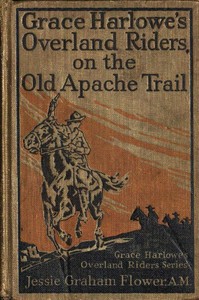
The catalog record for Grace Harlowe's Overland Riders on the Old Apache Trail — A Closer Reading provides practical reading context through 56,495 words, 4 hr 6 min estimated reading time, and 29 detected text sections.
The text analysis averages about 14.2 words per sentence, while the detected sections provide another way to judge how the source is divided.
Project Gutenberg metadata also associates the work with “Western stories,” connecting these edition facts with the source record’s subject description.
Explore this collection
These alternatives are selected using recorded categories and estimated reading time.
About 246 minutes
Childrens Adventures
56,498 recorded words. 0 minutes difference from this book's estimate.
View Gutenberg source #45530About 246 minutes
Childrens Adventures
56,532 recorded words. 0 minutes difference from this book's estimate.
View Gutenberg source #52018About 247 minutes
Childrens Adventures
56,753 recorded words. 1 minutes difference from this book's estimate.
View Gutenberg source #50824Search stored excerpts and compare books → Choose by your preferences →
Choices use stored catalog measurements. Estimates vary with reading speed. A shared category is a catalog label, not a claim that two books have the same argument or literary quality.
Search reads excerpt text stored with this catalog and links to its associated Gutenberg record. The connection is stored in the site database; this tool does not recheck that every excerpt is word-for-word identical to that external record. Excerpt search does not cover every chapter and does not verify historical publication dates.
Catalog snapshot checked: 2026-09-25. Coverage: 98 public books, 98 available source excerpts.
Calculated from edition completeness, EPUB availability, text structure and catalogue metadata. Not a user rating.
Total of 100 points, scaled to a 2.5-5.0 range. Editions with an empty description or a missing EPUB file are not scored.
Public-domain source text
The source text is kept in the dedicated reader, separate from this catalogue record and its commentary.
Josephine Chase, writing as Jessie Graham Flower, opens Grace Harlowe's Overland Riders on the Old Apache Trail with a chapter titled “The Call of the Wild,” immediately establishing a tone of brisk decision. The dialogue is marked by clipped imperatives: “You must, Emma” and “Put out the campfire!” commands Grace. Chase rarely lingers on interior feeling; instead, she conveys urgency through physical action and terse exchanges. Emma Dean’s repeated wails—“I can’t go any further!”—serve as a foil to Grace’s steady, practical orders, a pattern that recurs throughout the excerpts.
Chase builds tension through a call-and-response pattern between Grace and Emma. Grace issues short directives: “Lie down and try to get some sleep,” “Wake up! We must be going.” Emma answers with protests: “I simply can’t,” “I’m so lame and stiff.” This rhythm does more than characterize—it drives the plot forward, forcing decisions. Even when Grace admits uncertainty—“I fear we shall not find it, dear”—her tone remains measured. The bandits, too, speak in blunt commands: “All out, and keep your hands up!” Chase’s dialogue rarely exceeds a sentence or two, mirroring the characters’ focus on survival over reflection.
Chase describes the Arizona terrain with a surveyor’s eye for practical detail. Grace reads the landscape as a series of problems to solve: “the second canyon over there should lead us somewhere near our camp.” The narration notes specific features—a shelf of rock, a bush of mountain berries, a rippling stream—each presented as either a hazard or a resource. Verbs of movement dominate: “creeping from rock to rock, slipping and sliding.” The setting is never merely scenic; it is a puzzle that Grace must decode. Chase’s descriptions of the canyon’s deep shadow and the cold mountain stream ground the adventure in tangible, sensory experience.
Grace Harlowe speaks and acts with a calm that borders on impersonal. She “rightly surmised” a hiding place, “decided to make another change of course,” and “aimed for the upper left limb” of a bandit. Her language is precise, almost clinical: she reflects on “the exciting incidents of the last few hours” without emotional outburst. Even when Emma groans, Grace responds with a dry suggestion: “Perhaps you prefer to remain here and starve or be captured again.” This restraint gives her authority but also distances her from the reader. Chase never lets Grace’s voice slip into panic, keeping the narrative focused on problem-solving rather than fear.
Chase punctuates action with specific sound cues. A rifle bullet “pinged against a rock” and “ricochetted off with a weird zing—g—g—g.” The onomatopoeic spelling draws attention to the auditory texture of the scene. Elsewhere, silence is “heavy with significance.” These sound details serve as warnings and markers of danger. When the girls hide under a rock shelf, the absence of noise becomes a relief. Chase’s careful placement of sound—and its absence—creates a rhythm of tension and release, guiding the reader’s attention to what matters most in each moment.
Readers attentive to Chase’s craft will notice how she uses dialogue, landscape, and sensory detail to shape a story of endurance. The author’s choices—short commands, precise geography, and controlled emotion—create a narrative that moves steadily forward. This edition invites you to observe those choices as they unfold, tracking how each element contributes to the overall effect of a journey under pressure.
Reading about Grace’s clipped commands against Emma’s wails, I remembered how those steady voices carry the whole story forward. The same quiet authority seems to echo in The Flying Machine Boys in the Wilds; Or, The Mystery of the Andes — Themes and Context, where calm observation matters more than panic. Both feel like old friends who know exactly what to do.
Build a private reading journal entry for this title.









