About 249 minutes
The Phantom Treasure — Context and Discussion
Childrens Adventures
57,229 recorded words. 0 minutes difference from this book's estimate.
View Gutenberg source #46375
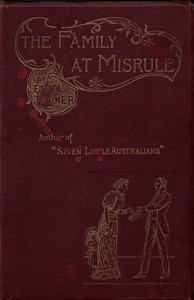
For The Family at Misrule — Edition Insights, the stored edition analysis reports 57,179 words, 4 hr 9 min estimated reading time, and 10 detected text sections.
The text analysis averages about 17.3 words per sentence, while the detected sections provide another way to judge how the source is divided.
Project Gutenberg metadata also associates the work with “Conduct of life -- Juvenile fiction,” connecting these edition facts with the source record’s subject description.
Explore this collection
These alternatives are selected using recorded categories and estimated reading time.
About 249 minutes
Childrens Adventures
57,229 recorded words. 0 minutes difference from this book's estimate.
View Gutenberg source #46375About 249 minutes
Childrens Adventures
57,185 recorded words. 0 minutes difference from this book's estimate.
View Gutenberg source #52809About 250 minutes
Childrens Adventures
57,330 recorded words. 1 minutes difference from this book's estimate.
View Gutenberg source #48467Search stored excerpts and compare books → Choose by your preferences →
Choices use stored catalog measurements. Estimates vary with reading speed. A shared category is a catalog label, not a claim that two books have the same argument or literary quality.
Search reads excerpt text stored with this catalog and links to its associated Gutenberg record. The connection is stored in the site database; this tool does not recheck that every excerpt is word-for-word identical to that external record. Excerpt search does not cover every chapter and does not verify historical publication dates.
Catalog snapshot checked: 2026-09-25. Coverage: 98 public books, 98 available source excerpts.
Calculated from edition completeness, EPUB availability, text structure and catalogue metadata. Not a user rating.
Total of 100 points, scaled to a 2.5-5.0 range. Editions with an empty description or a missing EPUB file are not scored.
Public-domain source text
The source text is kept in the dedicated reader, separate from this catalogue record and its commentary.
The Woolcot household at Misrule is introduced through a dispute over hemlines: Nell has let down a muslin frock to ankle length, and Meg, now twenty-one, objects on the grounds that fifteen-year-old Nell looks like 'playing at being grown up.' The argument reveals a central tension between the sisters—Meg's earnest attempts at domestic authority versus Nell's easy dismissal of 'morals.' Turner captures this friction through concrete details: the 'frou-frou of muslin frills,' Meg's freckles and her habit of making and breaking resolutions, and the pile of socks she darns as a token of duty.
Meg Woolcot at twenty-one is caught between her own youth and the role of surrogate mother. The opening chapter shows her darning socks for Pip and Bunty—a chore she sometimes neglects until 'Clean socks, Meg, and look sharp' forces her hand. Her desire to be a 'model eldest sister' coexists with her habit of writing verses and burning them, a private creative outlet that mirrors her brother Pip's more public poetic efforts. Nell, meanwhile, tests limits with her lengthened frock and upswept hair, insisting that 'fifteen's very old.' Turner uses these domestic skirmishes to map the siblings' shifting positions: Meg's authority is fragile, Nell's rebellion is stylish, and the household runs on a mix of affection and exasperation.
Pip's unrequited love for Mabelle Jones produces a torrent of verse, including a midnight composition he deems 'exceptionally fine.' Turner reproduces the full poem—a melodramatic meditation on death and despair—and follows it with Pip's disdain for 'mawkish, sentimental' love poetry, which he contrasts with his own 'strong' lines. The comedy sharpens when Mabelle returns the poem with a note dismissing it as 'poetery' and announcing her engagement to Mr. Wilkes, a man who sells frying pans and writes verse himself. Pip's mortification is complete when he learns his poem was shown to 'Ma and Pa and some one else.' The episode balances genuine adolescent anguish with self-parody, as Pip's grand gestures collapse into the mundane reality of a postscript signed 'Miss JONES (not Mabelle).'
Turner repeatedly contrasts the Woolcot children's impulses with the demands of household management. Meg's 'fresh resolve to do her duty in her state of life' leads her to darning socks, but the narrative notes that at other times she leaves them 'to the fag end of the week.' The verandah, lawn, and 'crazy-looking summer-house' provide a setting where Nell can parade her new frock and Meg can sigh. These details ground the family's emotional struggles in physical spaces and routines. The catalog subjects—'Conduct of life,' 'Obedience,' 'Country life'—are not abstract themes but lived frictions: Nell's defiance of Meg's dress code, Pip's neglect of his studies for poetry, and Meg's oscillation between resolve and procrastination all show how the Woolcots negotiate growing up within the loose structure of Misrule.
Readers familiar with Seven Little Australians will find the same sharp-eyed portrayal of sibling dynamics, but The Family at Misrule deepens the focus on the transition from childhood to adolescence. Turner's strength lies in the small, telling detail—a hemline, a burnt poem, a pile of un-mended socks—that reveals character without editorializing. Approach this sequel as a study in the comedy and pathos of growing up, where resolutions are made and broken, and the household at Misrule remains a place of affectionate discord.
There’s a moment in The Family at Misrule where Pip’s grand romantic misery makes me smile, all that youthful posing against the ordinary hum of home. It reminded me, oddly, of the fierce, clashing worlds in The White Conquerors: A Tale of Toltec and Aztec — Inside the Classic. Both carry that ache of change, where old certainties quietly give way.
Build a private reading journal entry for this title.









