About 263 minutes
The Phantom Yacht — Edition Insights
School Stories
60,365 recorded words. 3 minutes difference from this book's estimate.
View Gutenberg source #44401
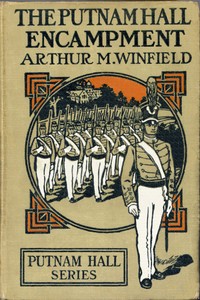
This digital edition of The Putnam Hall Encampment; or, The Secret of the Old Mill — Context and Discussion is described by source-level measurements including 61,160 words, 4 hr 26 min estimated reading time, and 9 detected text sections.
The text analysis averages about 12.1 words per sentence, while the detected sections provide another way to judge how the source is divided.
Project Gutenberg metadata also associates the work with “Schools -- Juvenile fiction,” connecting these edition facts with the source record’s subject description.
Explore this collection
These alternatives are selected using recorded categories and estimated reading time.
About 263 minutes
School Stories
60,365 recorded words. 3 minutes difference from this book's estimate.
View Gutenberg source #44401About 259 minutes
School Stories
59,346 recorded words. 7 minutes difference from this book's estimate.
View Gutenberg source #47451About 254 minutes
School Stories
58,310 recorded words. 12 minutes difference from this book's estimate.
View Gutenberg source #46404Search stored excerpts and compare books → Choose by your preferences →
Choices use stored catalog measurements. Estimates vary with reading speed. A shared category is a catalog label, not a claim that two books have the same argument or literary quality.
Search reads excerpt text stored with this catalog and links to its associated Gutenberg record. The connection is stored in the site database; this tool does not recheck that every excerpt is word-for-word identical to that external record. Excerpt search does not cover every chapter and does not verify historical publication dates.
Catalog snapshot checked: 2026-09-25. Coverage: 98 public books, 98 available source excerpts.
Calculated from edition completeness, EPUB availability, text structure and catalogue metadata. Not a user rating.
Total of 100 points, scaled to a 2.5-5.0 range. Editions with an empty description or a missing EPUB file are not scored.
Public-domain source text
The source text is kept in the dedicated reader, separate from this catalogue record and its commentary.
Edward Stratemeyer, writing as Arthur M. Winfield, populates the Putnam Hall series with a cast of cadets whose speech and actions are sharply differentiated. In The Putnam Hall Encampment, the author’s choices in diction and dialogue work to establish hierarchy, camaraderie, and conflict. The cadets’ banter is laced with nicknames and exclamations—"Hi, come back!" and "Gi—give me air!"—that convey immediacy and a youthful, colloquial tone. Meanwhile, the bully Reff Ritter’s dialogue is marked by growls and grudging admissions, such as "I suppose I’ll have to. But this ain’t fair," revealing his resentment through nonstandard grammar and reluctant phrasing.
Stratemeyer uses dialogue to distinguish the cadets’ personalities and social roles. The protagonist Jack Ruddy speaks with measured authority as Major, while Pepper Ditmore’s lines are quick and teasing: "Ritter, you’ll soon know how it feels to fly through the air!" The bully Ritter’s speech is consistently surly and defensive, using contractions like "ain’t" and short, clipped sentences: "I’ll apologize to nobody!" This contrast reinforces the moral hierarchy of the school, where the "good" cadets speak with playful confidence and the antagonist’s language signals his unreliability. The author also employs group dialogue—overlapping exclamations like "Say, you let me down!" and "Will you apologize?"—to create a sense of collective action and shared stakes.
The vocabulary of military life is woven into the narrative, but Stratemeyer often juxtaposes formal terms with informal actions. Words like "corporal of the guard," "post," and "roll" appear alongside descriptions of pranks and horseplay. When Ritter raises the alarm, he yells "Thieves! Robbers! Help!"—a melodramatic choice that contrasts with the actual situation, highlighting his manipulative nature. The author’s diction for the encampment setting includes specific terms like "swing rope" and "belts," grounding the action in the physical props of camp life. This blend of official and colloquial language mirrors the tension between the cadets’ duty and their desire for adventure.
Stratemeyer’s choice of verbs drives the slapstick energy of scenes like Ritter’s suspension. Ritter is described as "sprawling out like a frog and turning around and around," with the verb "sprawling" emphasizing his lack of control. The cadets "pulled on the rope with a will," and later Ritter "sank down on the ground" and "gasped" for air. These active, vivid verbs create a kinetic, almost cartoonish quality. The author also uses verbs of motion to structure the chase: Ritter "bounded" and "commenced to run," while the other cadets "skirted the woods on the double-quick" and "sped" past the guard. Such choices keep the narrative pace brisk and align with the boys’ perspective.
The encampment is rendered through brief but telling sensory cues. The alarm is described as a "loud alarm" that "woke the entire camp," and Captain Putnam comes "rushing from his tent." The night setting is implied by references to "stars" and the guard Hogan studying them, while the lakefront and woods are sketched with minimal but functional detail: "the water’s edge" and "the woods on the double-quick." Stratemeyer does not linger on description; instead, setting emerges from action. The old mill of the subtitle is not depicted in the excerpts, but the title promises it as a focal point. The author’s restraint in description keeps attention on dialogue and incident, a choice that prioritizes plot over atmosphere.
Readers attentive to Stratemeyer’s craft will notice how he builds character through speech tags and verb choices rather than interior monologue. The cadets’ world is one of external action and verbal sparring, where every "growled" or "cried" reinforces the social dynamics. The excerpts suggest a formula that rewards close reading of dialogue patterns and physical comedy. For those interested in early twentieth-century boys’ adventure fiction, this volume offers a clear example of how popular series authors used language to signal morality and maintain narrative momentum.
There's something about the way old Stratemeyer books hold their quiet—the cadets’ chatter, the mill’s shadow—that stays with you long after closing. Mamie's Watchword feels like that same kind of lingering, a softer echo of the same moral thread. I found myself thinking about it for days, not because of any grand drama, just its gentle, steady heart. The companionship between the pages felt familiar, like returning to an old bench in the sun. Mamie's Watchword — Reading Companion never raises its voice, and that’s exactly why it remains.
Use these questions to collect your thoughts before moving on.