About 176 minutes
Troubled Waters Sandy Steele Adventures #6 — Story, Setting & Ideas
Young Readers
40,447 recorded words. 2 minutes difference from this book's estimate.
View Gutenberg source #50353
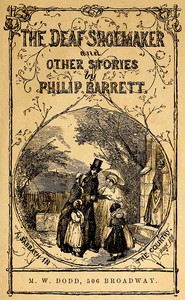
For The Deaf Shoemaker: To Which Are Added Other Stories for the Young — Context and Discussion, the stored edition analysis reports 39,987 words, 2 hr 54 min estimated reading time, and 93 detected text sections.
The text analysis averages about 23.1 words per sentence, while the detected sections provide another way to judge how the source is divided.
Project Gutenberg metadata also associates the work with “Children's poetry,” connecting these edition facts with the source record’s subject description.
Explore this collection
These alternatives are selected using recorded categories and estimated reading time.
About 176 minutes
Young Readers
40,447 recorded words. 2 minutes difference from this book's estimate.
View Gutenberg source #50353About 171 minutes
Young Readers
39,310 recorded words. 3 minutes difference from this book's estimate.
View Gutenberg source #50225About 161 minutes
Young Readers
36,882 recorded words. 13 minutes difference from this book's estimate.
View Gutenberg source #50257Search stored excerpts and compare books → Choose by your preferences →
Choices use stored catalog measurements. Estimates vary with reading speed. A shared category is a catalog label, not a claim that two books have the same argument or literary quality.
Search reads excerpt text stored with this catalog and links to its associated Gutenberg record. The connection is stored in the site database; this tool does not recheck that every excerpt is word-for-word identical to that external record. Excerpt search does not cover every chapter and does not verify historical publication dates.
Catalog snapshot checked: 2026-09-25. Coverage: 98 public books, 98 available source excerpts.
Calculated from edition completeness, EPUB availability, text structure and catalogue metadata. Not a user rating.
Total of 100 points, scaled to a 2.5-5.0 range. Editions with an empty description or a missing EPUB file are not scored.
Public-domain source text
The source text is kept in the dedicated reader, separate from this catalogue record and its commentary.
Philip Barrett addresses his young readers in the preface as "My Dear Young Friends," a phrase that sets the intimate, exhortatory tone running through this 1859 collection. The book gathers "scattered sketches" into a volume of prose and verse, each piece aiming to lead children toward "childhood's best and truest friend—the blessed Saviour." Barrett's authorial choices are evident from the first story: he uses direct second-person address, rhetorical questions, and vivid contrasts between earthly homes and a heavenly one. The excerpt from "Home" builds a scene of domestic happiness only to invert it with the certainty of death, a pattern that recurs across the collection.
Barrett consistently breaks the narrative frame to speak directly to his readers. In "Home," he writes "But, children, that pleasant home cannot always be the abode of happiness," using the vocative to create a sense of personal urgency. This technique appears throughout: the author inserts himself as a moral guide, warning against trifling away "your inch of time." The preface establishes this relationship explicitly, and the epistolary piece "To My Sabbath-School Class" extends it into a letter format. Barrett's diction is plain but emphatic, relying on repetition and parallel structure—"Sooner or later," "There will be," "How important then"—to drive home his lessons. The effect is less storytelling than sermonizing, with the author's voice functioning as a constant, pressing presence.
The poem "My Old Dear Home" offers a detailed inventory of a childhood dwelling: "Between broad fields of wheat and corn," a peach-tree against the wall, a barn with hay, an orchard, a spring with bulrushes. Barrett uses sensory specifics—the smell of hay, the robin's wing, the minnows—to anchor the reader in a tangible, beloved place. Yet the poem's refrain, "But the stranger's foot hath crossed the sill," introduces loss and displacement. This pattern of building a secure domestic scene only to undermine it recurs in the prose of "Home," where the "vacant chair" and "deserted hearth-stone" follow joy. Barrett's authorial choice is to make the physical home a symbol of transience, using concrete details to heighten the emotional and moral stakes.
The table of contents reveals a deliberate mix of genres: narrative sketches like "John McDonough," didactic pieces such as "The Alarm Watch," poems including "The Rose" and "Autumn," and a series of "Sketches for Young Men" with numbered parts. The poem "My Old Dear Home" stands out for its regular meter and rhyme, while the prose sections employ a looser, more conversational rhythm. Barrett also includes a letter dated "Lewisburg, Va., July 31st, 1858," addressed to his Sabbath-school class, blending personal anecdote with moral instruction. This formal variety suggests an author tailoring his approach to different didactic aims: verse for emotional resonance, narrative for exempla, and direct address for exhortation. The collection thus functions as a repertoire of instructional modes.
Death appears as a constant thematic thread. In "Home," Barrett writes that "some member of that family will be locked in the cold embrace of Death" and warns that "he who to-day resides in the costliest mansion, may to-morrow be an inhabitant of a hovel." The poem "My Old Dear Home" similarly dwells on absence and the stranger's occupation. Heaven is presented as the only stable home: "a house not made with hands, whose builder and maker is God." Barrett repeatedly urges his young readers to act now—"Seek the Lord while he is near"—framing time as a limited resource. The phrase "inch of time" captures this urgency. These motifs are not developed through plot but through direct statement and repetition, making the collection less a narrative work than a series of moral admonitions.
Readers approaching Barrett's collection should expect a work driven by explicit moral purpose rather than narrative suspense. The author's voice is constant and personal, addressing children as a teacher or pastor might. The poems and stories reward attention to their concrete domestic details, which Barrett uses to ground abstract spiritual lessons. Because the excerpts represent only a portion of the 93 sections, the full range of Barrett's formal experiments—and the cumulative effect of his recurring motifs—can best be assessed by reading the volume sequentially.
That old book lingers like a quiet room after the story ends—the way home and loss and faith get tangled together gently. I kept thinking of its soft, earnest voice while remembering another one,Adventures of Sonny Bear — Context and Discussion, which holds that same unhurried warmth, like a hand resting on a shoulder without needing to say anything more.
Your answers remain private and are stored only in this browser.