About 247 minutes
Among the Esquimaux; or, Adventures under the Arctic Circle — A Closer Reading
Young Readers
56,767 recorded words. 19 minutes difference from this book's estimate.
View Gutenberg source #45192
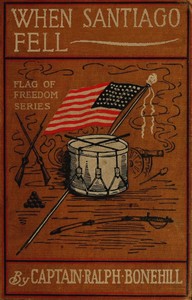
The catalog record for When Santiago Fell; or, The War Adventures of Two Chums — Text and Context provides practical reading context through 61,027 words, 4 hr 26 min estimated reading time, and 7 detected text sections.
The text analysis averages about 15.8 words per sentence, while the detected sections provide another way to judge how the source is divided.
Project Gutenberg metadata also associates the work with “Conduct of life -- Juvenile fiction,” connecting these edition facts with the source record’s subject description.
Explore this collection
These alternatives are selected using recorded categories and estimated reading time.
About 247 minutes
Young Readers
56,767 recorded words. 19 minutes difference from this book's estimate.
View Gutenberg source #45192About 231 minutes
Young Readers
53,105 recorded words. 35 minutes difference from this book's estimate.
View Gutenberg source #45457About 208 minutes
Young Readers
47,663 recorded words. 58 minutes difference from this book's estimate.
View Gutenberg source #44133Search stored excerpts and compare books → Choose by your preferences →
Choices use stored catalog measurements. Estimates vary with reading speed. A shared category is a catalog label, not a claim that two books have the same argument or literary quality.
Search reads excerpt text stored with this catalog and links to its associated Gutenberg record. The connection is stored in the site database; this tool does not recheck that every excerpt is word-for-word identical to that external record. Excerpt search does not cover every chapter and does not verify historical publication dates.
Catalog snapshot checked: 2026-09-25. Coverage: 98 public books, 98 available source excerpts.
Calculated from edition completeness, EPUB availability, text structure and catalogue metadata. Not a user rating.
Total of 100 points, scaled to a 2.5-5.0 range. Editions with an empty description or a missing EPUB file are not scored.
Public-domain source text
The source text is kept in the dedicated reader, separate from this catalogue record and its commentary.
The preface to When Santiago Fell declares the book aims to present “a true picture of life in the Cuba of to-day” and show the struggle before U.S. intervention. The opening chapter, “Off for the Interior,” launches directly into action with a rush on an ox cart, but the excerpts provided reveal that the novel’s early momentum is soon interrupted by lengthy embedded narratives. A first reader should note how the author balances adventure with historical context, often through characters recounting past events.
The preface, signed by “Captain Ralph Bonehill” (a pseudonym for Edward Stratemeyer), frames the story as both entertainment and instruction. It explicitly states the time covered is “the last year of the Cuban-Spanish War and our own campaign leading up to the fall of Santiago.” Stratemeyer anticipates that some readers may find the adventures “over-drawn,” but he defends them by citing the brutality of the conflict. This prefatory note primes the reader to expect a blend of thrilling episodes and earnest historical backdrop. The author’s direct address to “my numerous young friends” also signals a pedagogical tone that recurs in the narrative.
A substantial portion of the excerpts consists of Señor Guerez narrating his own backstory to the young protagonist, Mark. This embedded tale covers his decision to join the Cuban forces, a skirmish with Spanish guerrillas, and the capture of Mark’s father. The narrative shifts from third-person action to first-person recollection, creating a pause in the forward momentum. Readers should observe how this technique delivers historical exposition—details about General Garcia, the use of a convent as a refuge, and the charge of espionage—while also deepening character motivation. The voice of Guerez is formal and measured, contrasting with the more breathless adventure scenes.
Across the excerpts, certain details recur: the danger of wearing a Cuban uniform, the threat of being labeled a spy, and the precarious safety of women and children. Guerez explains that Mark’s father was caught “wearing a Cuban uniform” and is to be sent to Santiago as “an American spy.” Earlier, Guerez himself describes shooting Spanish guerrillas who threatened his wife. These elements reinforce the novel’s central tension—loyalty and identity in a guerrilla war. The repeated mention of uniforms and false charges suggests that the book uses these motifs to explore the chaos of war, where appearances can be deadly.
The excerpts show a clear structural pattern: a brief burst of action (the ox cart halt, the escape from the gunboat) followed by extended dialogue or narration that explains the situation. For instance, the opening chapter title “Off for the Interior” promises movement, but the provided text quickly settles into Guerez’s long speech. This rhythm may test a reader expecting non-stop adventure. However, it also allows Stratemeyer to layer in historical details—such as the mention of Brigadier General José Maceo and the old convent—without breaking the story’s frame. A first-time reader might benefit from treating these expository passages as integral to the novel’s educational purpose.
The excerpts from When Santiago Fell reveal a work that oscillates between rapid-fire incident and deliberate historical scene-setting. Readers who approach the book with an awareness of its dual aims—to thrill and to instruct—will find that the embedded narratives reward patience. The novel’s structure, with its long speeches and detailed backstories, reflects Stratemeyer’s effort to ground his chums’ adventures in the specific realities of the Cuban-Spanish War.
Stratemeyer's chums pause mid-chase for Señor Guerez’s quiet history, and I found myself drifting to that other volume, likewise framed by an editor’s gentle hand. Both feel less like action than like remembering. There’s a particular softness in how The Girl Warriors: A Book for Girls — Text and Context slows its own footsteps, asking me to sit with the backstory rather than rush past it.
Your answers remain private and are stored only in this browser.