About 240 minutes
Lost in the wilds — Text and Context
Fairy Moral Tales
55,128 recorded words. 19 minutes difference from this book's estimate.
View Gutenberg source #43640
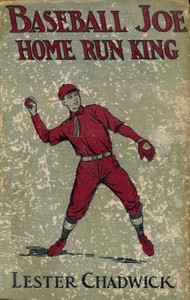
For Baseball Joe, Home Run King; or, The Greatest Pitcher and Batter on Record — Inside the Classic, the stored edition analysis reports 59,400 words, 4 hr 19 min estimated reading time, and 7 detected text sections.
The text analysis averages about 16.3 words per sentence, while the detected sections provide another way to judge how the source is divided.
Project Gutenberg metadata also associates the work with “Conduct of life -- Juvenile fiction,” connecting these edition facts with the source record’s subject description.
Explore this collection
These alternatives are selected using recorded categories and estimated reading time.
About 240 minutes
Fairy Moral Tales
55,128 recorded words. 19 minutes difference from this book's estimate.
View Gutenberg source #43640About 234 minutes
Fairy Moral Tales
53,648 recorded words. 25 minutes difference from this book's estimate.
View Gutenberg source #43853About 214 minutes
Fairy Moral Tales
49,035 recorded words. 45 minutes difference from this book's estimate.
View Gutenberg source #44293Search stored excerpts and compare books → Choose by your preferences →
Choices use stored catalog measurements. Estimates vary with reading speed. A shared category is a catalog label, not a claim that two books have the same argument or literary quality.
Search reads excerpt text stored with this catalog and links to its associated Gutenberg record. The connection is stored in the site database; this tool does not recheck that every excerpt is word-for-word identical to that external record. Excerpt search does not cover every chapter and does not verify historical publication dates.
Catalog snapshot checked: 2026-09-25. Coverage: 98 public books, 98 available source excerpts.
Calculated from edition completeness, EPUB availability, text structure and catalogue metadata. Not a user rating.
Total of 100 points, scaled to a 2.5-5.0 range. Editions with an empty description or a missing EPUB file are not scored.
Public-domain source text
The source text is kept in the dedicated reader, separate from this catalogue record and its commentary.
From the first line of batting practice—"I'm going to tie you up in knots, old man"—Lester Chadwick's Baseball Joe, Home Run King establishes a pattern of friendly rivalry that threads through its baseball scenes. The novel moves briskly between the diamond and private moments, with the Polo Grounds serving as a stage for record hits and the spaces between games given over to romantic banter and surprise visits. The structure relies on sharp transitions: a chapter may open with a dangerous plunge or a stolen base, then shift to a hotel suite where Joe and Mabel exchange private jokes. This alternation between public performance and personal intimacy gives the story its particular rhythm.
The narrative alternates between high-energy baseball sequences and quieter, domestic interludes. A chapter titled "A Dangerous Plunge" is followed by "A Surprise," where the action pauses for a reunion at a crowded station. The text lingers on the greetings—"a hubbub of delighted and incoherent exclamations"—before moving to a hotel suite where the couples separate into rooms for private conversation. This structural pattern repeats: a game or practice is followed by a social scene, such as a matinee or an automobile ride. The baseball chapters themselves build tension through play-by-play detail, while the intervening chapters release that tension through dialogue and romantic byplay. The effect is a deliberate pacing that mirrors the rhythm of a baseball season: bursts of effort followed by recovery.
Two images recur throughout the excerpts: the act of tying and untying, and the motif of speed. The opening exchange—"I'm going to tie you up in knots" / "untying knots is the best thing I do"—frames pitching and hitting as a contest of control. Later, Joe hires a "speedy car" and drives without a chauffeur, emphasizing his mastery over motion. The automobile ride on Long Island echoes the earlier baseball action: both require skill, confidence, and the ability to navigate risk. The text also uses the word "whirled" to describe the taxicab ride to the hotel, linking the velocity of the game to the pace of the characters' lives. These images reinforce Joe's identity as someone who controls speed—whether of a fastball or a car—and who thrives on the edge of danger.
The story's geography is defined by sharp transitions between public and private settings. The Polo Grounds, the training camp, and the crowded station are spaces of performance and observation. In contrast, the hotel suite offers a retreat where characters speak "in an undertone" and exchange "things equally precious to themselves." The narrative moves between these realms with little transition: a chapter may end at the ballpark and begin in a parlor. This structure emphasizes the contrast between Joe's public role as "Baseball Joe" and his private life as a young man in love. The station scene, where greetings are constrained by the crowd, explicitly dramatizes the tension between public visibility and private desire. The text notes that "of course in the crowded station the greetings could not be just what the boys—and the girls, too—desired," highlighting the characters' need for spaces apart.
Secondary characters like Reggie and Clara serve as structural devices that facilitate movement between scenes. Reggie, who "came in for warm handshakes" but is quickly dismissed to "look after the luggage," provides a comic counterpoint and a means of clearing the stage for the romantic leads. Clara, meanwhile, is positioned as an informed spectator: she knows "all the phases of his rapid rise" and watches Jim pitch from a box. Her presence motivates Jim's perfect game, and the narrative uses her to validate his success. These characters are not fully developed but are functional, enabling the story to shift from group scenes to intimate duets. The text's treatment of them—Reggie excusing himself for an engagement, Clara and Jim occupying a separate room—reinforces the novel's pattern of pairing off and moving between public and private spheres.
Readers attentive to structure will notice how Chadwick uses the spaces between games—the automobile rides, the hotel rooms, the station platforms—to develop character relationships and vary the story's tempo. The novel's reliance on sharp scene shifts and recurring motifs of speed and control rewards a focus on how the narrative moves, not just what happens. Pay particular attention to the way each baseball chapter is paired with a social chapter, and how the private moments echo the public ones in miniature.
Sometimes I catch myself lingering on how that old baseball story kept shuttling between cheering crowds and quiet hotel rooms, the rhythm of noise and hush feeling almost like a heartbeat. That same pulse seems to run through Red Dynamite A Mystery Story for Boys — A Closer Reading, though there the spaces feel darker, more whispered. Both books breathe in that peculiar, patient way of old boys' fiction—and I find that oddly comforting.
Save your reaction, strongest insight, and memorable passage.