About 108 minutes
Nelly's First Schooldays — Background and Themes
Fairy Moral Tales
24,789 recorded words. 26 minutes difference from this book's estimate.
View Gutenberg source #43697
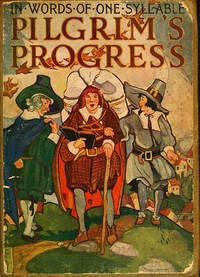
Bunyan's Pilgrim's Progress: In Words of One Syllable — Story, Setting & Ideas can be approached with a clearer sense of reading commitment from its source measurements: 30,647 words, 2 hr 14 min estimated reading time, and 4 detected text sections.
The text analysis averages about 23.3 words per sentence, while the detected sections provide another way to judge how the source is divided.
Project Gutenberg metadata also associates the work with “Christian life -- Juvenile fiction,” connecting these edition facts with the source record’s subject description.
Explore this collection
These alternatives are selected using recorded categories and estimated reading time.
About 108 minutes
Fairy Moral Tales
24,789 recorded words. 26 minutes difference from this book's estimate.
View Gutenberg source #43697About 103 minutes
Fairy Moral Tales
23,500 recorded words. 31 minutes difference from this book's estimate.
View Gutenberg source #43807About 183 minutes
Fairy Moral Tales
42,061 recorded words. 49 minutes difference from this book's estimate.
View Gutenberg source #43793Search stored excerpts and compare books → Choose by your preferences →
Choices use stored catalog measurements. Estimates vary with reading speed. A shared category is a catalog label, not a claim that two books have the same argument or literary quality.
Search reads excerpt text stored with this catalog and links to its associated Gutenberg record. The connection is stored in the site database; this tool does not recheck that every excerpt is word-for-word identical to that external record. Excerpt search does not cover every chapter and does not verify historical publication dates.
Catalog snapshot checked: 2026-09-25. Coverage: 98 public books, 98 available source excerpts.
Calculated from edition completeness, EPUB availability, text structure and catalogue metadata. Not a user rating.
Total of 100 points, scaled to a 2.5-5.0 range. Editions with an empty description or a missing EPUB file are not scored.
Public-domain source text
The source text is kept in the dedicated reader, separate from this catalogue record and its commentary.
Samuel Phillips Day's Bunyan's Pilgrim's Progress: In Words of One Syllable (1895) condenses John Bunyan's allegory into a vocabulary of only single-syllable words, a constraint that reshapes the narrative's rhythm and texture. The opening scene—Christian in rags, with a book and a great load on his back—retains its emotional weight: 'he wept and shook,' and his wife and children are called 'bairns,' a Scots term that adds a homely, archaic flavor. The language forces a stark, almost biblical cadence, as in 'death is my doom' and 'I do not will to do.' This edition, part of a series by Day that also includes Reynard the Fox, aims to make the classic accessible to young readers while preserving its moral urgency.
Day's self-imposed rule—every word must have one syllable—creates a distinctive prose style. Common polysyllabic terms are replaced: 'burden' becomes 'load,' 'despair' is 'grief,' and 'salvation' is implied rather than named. The result is a text that moves with a clipped, deliberate pace. For instance, the Slough of Despond is described simply as a 'bog,' and the Hill Difficulty is just 'the hill.' This simplification sometimes forces inventive circumlocutions: 'the Celestial City' remains, but 'Evangelist' is kept as a proper name. The constraint also affects dialogue, making exchanges like 'Why dost thou cry?' feel direct and unadorned. Young readers encounter a stripped-down version of Bunyan's theology, where concepts like 'grace' and 'faith' are embedded in action rather than abstraction.
The Vanity Fair episode illustrates how Day's language choice heightens the alienation between pilgrims and townspeople. Christian and Faithful 'spoke the tongue of Canaan,' while the fair-goers are 'men of this world'—a linguistic divide that underscores their spiritual difference. The fair sells 'lands, trades, realms, lusts, and gay things of all sorts, as lives, blood, souls, gold, pearls.' The list, built from one-syllable nouns, feels both concrete and exhaustive. When the pilgrims refuse to buy, they 'stop their ears, and cry, Turn off mine eyes, lest they see vain things.' The trial before Lord Hate-good is rendered with stark clarity: the judge's name itself is a one-syllable compound, and the charge—'that they had made broils and feuds in the town'—uses plain terms for conflict. The cage and stocks become physical symbols of persecution, described without embellishment.
Day's prose relies on parallel structures and repeated phrases to maintain momentum. The opening dream sequence uses 'I saw' as a refrain: 'I saw a man clad in rags... I saw him read... I saw, too, that his eyes went this way and that way.' This pattern mimics biblical narrative and gives the text a hypnotic quality. Later, when Christian and Hopeful are in Doubting Castle, the repetition of 'they did' and 'they were' builds tension. The constraint also forces short sentences that can feel abrupt: 'In this plight, then, he went home, and kept calm as long as he could.' The effect is a story that moves quickly from one event to the next, with little descriptive padding. Readers familiar with Bunyan's original will notice the omission of many theological dialogues; Day focuses on plot and moral crisis, making the allegory more a series of vivid trials than a doctrinal treatise.
This edition offers a unique entry point to Bunyan's work, where the linguistic restriction becomes a lens for seeing the story's core conflicts. Readers may compare Day's choices with the original to appreciate how vocabulary shapes tone and meaning. The book is best read aloud, as the rhythm of one-syllable words gives the narrative a folk-tale quality. For those new to Pilgrim's Progress, this version provides a clear, uncluttered path through Christian's journey, while seasoned readers will find interest in Day's craft.
Reading about Christian’s trials at Vanity Fair, reduced to those bare, one-syllable words, left me feeling oddly quiet. The starkness made his loneliness more real, somehow. It brought to mind that old adventure story, Tom Fairfield in Camp; or, The Secret of the Old Mill — Background and Themes, where a boy’s own solitude in a strange place carries a similar weight, though his journey is far lighter. A shared sense of wondering what comes next.
Answer a few questions and save a private reflection on this device.